Thursday, January 17, 2008

never center the subject

never center the subject

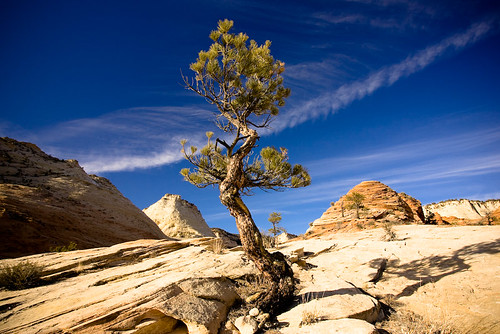
Never center the subject. All the good photographic books tell you that. Unless of course you want to. This tree has so much staying power, that for me, I wanted it bang in the center of the frame. Static. Dominant. A very centered composition communicated that in a way that a perhaps more aesthetically pleasing offset arrangement doesn't, to my eye. Compositional rules and guidelines are great when you are starting out. But really, they are short summaries of deeper truths or ideas. I think you really need to take the time to understand the motivation behind those guidelines, so that you can make compositions say what you want them to say.
Behold the apples’ rounded worlds: juice-green of July rain, the black polestar of flowers, the rind mapped with its crimson stain. - Apples, Laurie Lee
I think of it in the same way that you learn grammar at school. The correct way to put sentences together, to provide meaning. Perfectly apt for a business letter or formal discussion. Not so great to really let you see and smell the apple. Visual language has many of those constructs and guides, that should be equally well thrown away when appropriate to the story. I think it is important to spend the time to learn the conventions and ideas in classical composition. But try to go beyond the how-to books that superficially list the ideas. Work out what these visual arrangements say. Work out what you want to say. Use what expresses your ideas most clearly.

SoFoBoMo

zion

Paul Butzi is putting the finishing touches to the Solo Photo Book Month challenge. I want to urge you to take part. Not for me. Not for Paul. For you. But why would you want to put a book together ? All photographers seem to want to put a book together. It is a cool thing to do - to have a book of your images, in your hand. We print few enough images any more. Digital photographers have drives stuffed full of digital images and not enough printed. At least I fall in to that category and I suspect many of you do, too. Lots of unfinished images, cluttering up the place. Maybe some of them get released into the wild and end up on flickr. Even there though, they are seldom solid enough for you to really look at them. A single finished print teaches you a lot about the image that is hard to discover on a screen. A book is a different order of magnitude, again. Final. Solid. Scary.

That I think is why many of us don't do it. A book seems like such a big task. Daunting and also final. You have to commit to the content of it. Those pictures are there to last. So all the fears well up. I'm not good enough. I don't know how to do it. I don't think I can finish it. Who am I to be putting a book together? Well, why not ? Even if you are the only person who ever sees the finished book, you'll have achieved something. The end result is a completed, finished piece of work - as polished as you can make it. It might be a file generated with a free pdf printer from any word processor, or a presentation tool, even Microsoft works or Adobe InDesign. It could be a blurb.com or lulu.com print-on-demand work. Perhaps you use it as something to approach a publisher with. It might just stay on your hard drive, never to be seen by anyone other than you. But it would still be a finished book. With your name on the cover. How cool would that be ?

But a book is a big commitment and a lot of work. That to me is the beauty of the SoFoBoMo challenge. It isn't a huge commitment. It'll all be over in a month, one way or another. You'll either have a book, or you won't. It can't stretch out into a multi-year or multi-decade albatross around your neck. You finish it, or you don't. So the scale is a whole lot smaller. The opportunity to procrastinate and prevaricate over choices or deciding when it is done just isn't there. The required number of pictures isn't too high - 35 - but enough that you'll need to engage, think about it and make an effort. Along the way you'll learn about editing your images - making those final painful choices on what to include or not. You'll probably learn a bit about book layout, design and what goes in to making a book. You'll find out how good you are at working to a deadline - or not. You'll actually finish something. That in particular is powerful stuff. It forces you to make decisions and live with them. You might find you don't like those decisions afterwards and that way, you'll have learned more than if you never started. I'm sure once you finish the first one that the next book will be that much more like what you actually want to create. If you never finish, you'll never get to start the next one and the next one and the next one.

The challenge would also be a fantastic opportunity to pick a project and shoot images on a consistent theme or subject. Return to a theme multiple times. Explore it. Go a bit deeper than those great one off images you always take. Or start a new short-term project if you normally work on projects already.

So give it a go. Sign up and commit to participating in SoFoBoMo. Make a book.

Tuesday, January 15, 2008

edit boldly

Editing is important. Really important. 99% of what you shoot is probably bad. 99% of what I shoot certainly is. But I try then to only show the good 1%. I struggle to make decisions about which images I like, or not. I don't show all the variations on a particular image. I'll spend the time to pick the version that really says what I want to say. I think that's important for several reasons. Firstly, it keeps the viewer interested. I'm showing them the best shots - in my opinion. I'm not putting out five variations of each image and expecting the viewer to pick the one they like. For one thing, that gets boring very quickly for the viewer. Secondly, it stops me from developing my own viewpoint. If I ask you to pick, you'll decide which one you like - but that one will be different for every viewer. If I make the choice - you might not like it, but it is my view. My style. My statement about what I wanted to show you. As I go along, picking the images I like, I refine my view. The next time I go and shoot I'll make some of those choices before I press the shutter. I'll have refined my own personal way of seeing and spend more time heading in an interesting direction. Hopefully I can go further on that second attempt than the first time. Editing is a big part of that process. You have the time to contemplate the images and pick what works, for you. You get to reject what doesn't work, for you. You can start to express yourself more strongly, by what you don't show people, just as much as you can with what you do show. If you find yourself unable to pick between two shots, or want to upload both versions, try anyway to pick one. If you can't, then there can't be anything different about them - so just pick either one. But if there is a difference, pick the one you personally like. Be bold. Make a decision. Edit bravely. I also have the luxury of not being paid for many of the shoots I do. People ask me to take a picture or a portrait because they like my previous images, or I ask them to let me shoot. They've asked me to take the picture and part of that is I get to decide what I show them and what I don't. Often I get asked if there are any more - but part of my process is that I get to decide what they see. I edit the images, so there aren't any more that I think were good enough. If I start showing all the images or giving them permutations and choices, the perception of the quality drops. I didn't share those other images in the first place, because I believe the best images are in the final edit, not in the discarded shots. Someone might not agree with my particular choices, but that's part of expressing your own style. This editing process helps later when you shoot, as you start to know when to stop shooting. I find more often than not, that either the first or last image in a sequence is the best one. Either everything fell in to place straight away and the first shot was great. Or, I'm sketching and striving towards an idea that I know is there - once I get it, I move on fairly soon afterwards. Editing heavily after the shoot, helps inform me when I'm shooting if I've got the shot or not. I know more about what I like and what I'm aiming to get. So I can shoot more variety. I don't keep working on the same idea once I've got the shot. I can move on and expand the options. If I shoot just one idea over and over again, that'll be the best shot I'll get all day. If I can edit and understand when I'm done with an idea, I can take more distinct images or ideas. The more I shoot the luckier I tend to get with the results. The collage above (click it to see a larger version) shows all the images I took last week. There are 6 images ringed which are my favourites, but really there is only one shot that I like from the whole day. 393 shots. One good one. Some of the sequences were shot in burst mode, in part to get her attention. But you can see the variety of locations, lighting and styles we went through. Lots of shots to get good expressions too.

Monday, January 14, 2008

slowing down

zion

It often takes me a while to slow down when I start photographing a scene. This weekend we did a flying visit to Zion national park. I flew out to Las Vegas late on Thursday evening and spent the night there, catching up with Amanda, who'd been working at the Consumer Electronics Show. We stayed the night in Vegas then drove out to Zion early on the Friday morning. I was surprised how quickly we got there - it is only about two and a half hours drive from Las Vegas to Springdale in Utah, which is right at the entrance to the park. We stayed at the Red Rock Inn in Springdale. It is in a great location, about 10 minutes drive from the park entrance. The rooms were good and clean and the price was pretty good too. Recommended if you need somewhere to stay in the area. I knew we only had a day and a half in the park, so I was keen to get going. I'd brought a few lenses and tripod and wanted to do some photography as well as hiking the trails. We headed in and drove along the Zion canyon access road - marveling at the amazing colours of the rock and the dramatic cliff faces on either side. It had snowed about a week earlier and there was still patches in the shaded areas on the canyon walls and floor. The Virgin River flows along side the road for most of the way and I kept wanting to stop and shoot reflections of light in the water. Our first real stop was the river walk trail, at the far end of the canyon. We walked in about half a mile and reached a 'trail closed' sign, due to falling ice. I tried shooting a bit, but always felt hurried. Partly because I knew Amanda was waiting on me but mainly because I kept feeling like I was missing something else, somewhere else. Amanda was very patient, but still I felt rushed. My mind kept wanting to jump forward to the next photo op, or worrying about where to be for sunset. Or trying to think where would be a good option for sunrise the next day. Or what it would be like in Autumn. It had been non-stop travel for me from Thursday afternoon to Friday afternoon and I think I was still mentally moving on, all the time. I took a few shots that I actually quite like, but never felt I could really settle in and be present in the moment. I felt the same way the next morning at sunrise - I was in a good location with some fairly uneventful skies, but I kept wanting to be somewhere else, worrying that I was missing a good opportunity further down the trail or over the next hill. I know the opportunities where there in front of me too, but I couldn't seem to bring my attention to where I was - time pressure, location anxiety, combined to give lack of attention. Finally on Saturday afternoon I managed to slow myself down and just enjoy where I was. I sat and looked for a while, enjoyed the view, spent a bit of quiet time on my own, shooting and thinking. We hiked the hidden canyon and emerald pools trails in the morning and had a lovely lunch on a log by the river. Then that afternoon we drove out through the East side of the park in the higher country and I walked off onto the rocks and shot, while Amanda read a book. The sun was warm and the skies were dramatically blue. There were lots of interesting patterns and swirls in the rock and I started to be more present in the moment. It always takes me a day or two to really start getting to grips with being in a location - so having the trip last a day and a half was a challenge to get back to landscape photography. In particular, I seem to get more ideas after looking at shots about how I want to approach it the next time. I find I have to revisit the same subjects a couple of times before I can really start to get the shots I want. Perhaps there is some amount of previsualisation I can work on to help get there more quickly, but even then I think I can create more compelling images with multiple attempts at a subject. That seems true for all my photography, not just these grand landscapes. In part that's why I think projects are such a good idea for improving photography. Coming to the same subject over time allows your approach to it to mature and lets you explore it more deeply. Constantly jumping from subject to subject can only really let you show a superficial aspect of it. People, National Parks, flowers; all the same, all benefit from longer term study and shooting. Zion is a beautiful place and we both had a great time hiking there. I hope to go back and spend a bit more time trying to photograph it. I happened to read a great piece of writing today about finding serenity and calm. It really struck a chord with me and my rush around Zion. What do you find works for you to make you slow down and be in the moment ?

zion

zion

Loved the colours I found in Zion. Deep reds and oranges. Towering walls, dramatic drop-offs. I think we'll be going back again.

These trees amazed me - such a narrow ledge, so high up.

Saturday, January 12, 2008

virgin river, zion

virgin river, zion

Flowing water and light reflecting from the canyon walls.

Friday, January 11, 2008

black & light

black & light

Zion National Park on the riverwalk to the Narrows

Monday, January 07, 2008

vivian

vivian100mm 1/640 sec @f3.5 ISO 640
Visited some friends yesterday and we spent an enjoyable afternoon chasing their not-quite one-year old around the house to get some pictures. Kids are such a challenging photographic subject but so much fun. Get down low, play around, shoot tons and hope. Going for shallow depth of field with such a fast moving subject makes it even more of a challenge to get some with just the right focus. I did get a few okay shots out of the 400+ that I took.
This one here is my favourite. I used some almost out-of-focus palm fronds as a bit of a framing element behind her head and I really like the way the leaves mirror the shapes of her eyelashes and also mirror the way her hair is falling over her forehead. She is looking upwards towards a bright, cloudy sky that has filled her face and eyes with bright, even, beautiful light. Also got to play with a new toy that Amanda got me for Christmas. I was lucky enough to get a Canon ST-E2 flash trigger. This way I can set up a strobe and have the camera communicate and control it, using through the lens exposure metering to control the flash power level. Quite different from the manual control of a pocket wizard and really helped out shooting indoors with such a fast moving subject. I just pointed the flash towards a white wall and used it as a room-sized softbox for all the shooting I did. The ST-E2 did well, triggering the flash every time, even when the camera and sensors were nowhere near pointing towards each other. Very happy with it. Here's an example of one mostly lit by the flash, mixing well with the window light behind her.
100mm 1/160sec @ f2.8 ISO 400
In the comments, Holly asked That flash device sounds intriguing...what did you do with the flash while you were shooting? Was it on a light stand or something? (how did you get it to bounce where you wanted?) I had the flash on the small stand that it comes with. This is basically a foot that lets the unit stand on a table or the floor. All I did then was swivel the head to point at a wall, with the IR sensor turned to face roughly towards the room/camera. The biggest problem was stopping Vivian crawling straight towards the flash to find out what it was.

Saturday, January 05, 2008

book design

red

Book design. I know nothing about it. Looking back at the three previous PDF portfolios I've put together, not only do I know nothing about it, but I'm obviously terrible at it. Embarrassingly, painfully bad. I can see that those first efforts are ghastly, but I'm not aware enough to know why, or how to fix it. For grins, here are links to my first three folio/ book attempts - that mostly look like the bad powerpoint presentations that they are. I did find a good book on Safari yesterday and got through the first half last night. The Non-Designer's Design Book by Robin Williams doesn't claim to be teaching good book design but it at least has taught me some of the fundamentals and opened my eyes to be able to see what is wrong. I think that's the first big step - if I know it isn't good and can identify what's wrong, I'm on the path to finding out how to make it look better. The book is based around the fantastically unfortunate set of four steps. Contrast, Repetition, Alignment and Proximity are the keys that good design is unlocked with. The first half of the book demonstrates how these four elements combine to improve layout and simplify design. The second half delves into aspects of typography and font selection. The CRAP principles seem easy enough to apply and more than that, my eye is now a bit more sensitive to what is actually needed to improve a design. I've taken my first few steps in understanding the language of book design, at least.

Thursday, January 03, 2008

looking for suggestions

newyear_2588-1

I know a few people read this blog. I don't usually get many comments though. So a plea for some input on this one. If you read it and have an idea or a favourite exercise - please post it. Don't worry about it being original or concerned that I've heard of it before - I want to know what you yourself have enjoyed or find helpful. I'll do the filtering later. A common brainstorming exercise is to just get it out there and worry about how useful it is later - so let us try that - please comment. I'm going to allow anonymous and non-signed in comments for this post - so you don't even need a blogger account. I may use any suggestions you provide, though, so don't comment if you are concerned about that.
If even half of the people who read this blog provides one idea, I'll be swamped with suggestions and that would be great. So with that said, I'm looking for the self-assignments or mini-projects that you've found valuable to get you out into the field and shooting. I'd like to hear what your favourite creativity exercises have been, what worked, what sparked your imagination. I don't need much, just a couple of lines explaining the exercise - I'll do the rest. Something like 'shoot your favourite colour' has worked well for me in the past and provided a good focus for a couple of hours of shooting. You don't have to go in to much more detail than that, if you don't want to. Or if you have a favourite exercise that's more involved, feel free to describe it in as much detail as you like. As an incentive - a free, signed copy of the book (when & if I get it finished) to the person who submits my favourite new exercise. If you submit an anonymous entry I won't be able to tell who you are though, so only those with some way to contact them will be eligible for this. If you don't want to post a comment or suggestion publicly, you can also email it to me at ideas@mcgregorphoto.com