Showing posts with label growth. Show all posts

Wednesday, May 27, 2009

making progress

captex-59

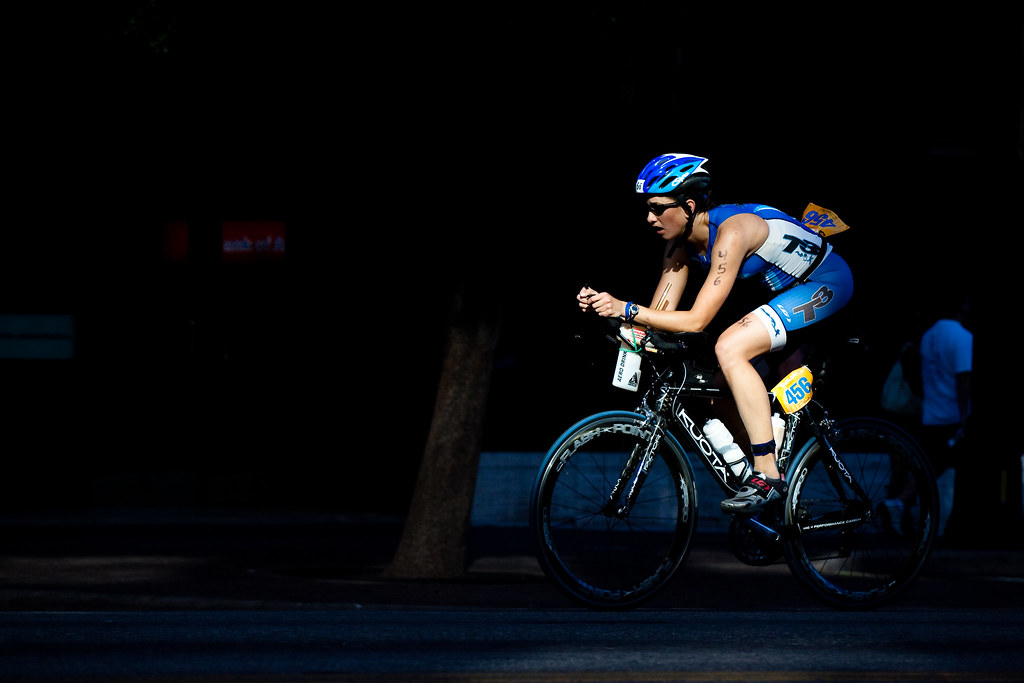
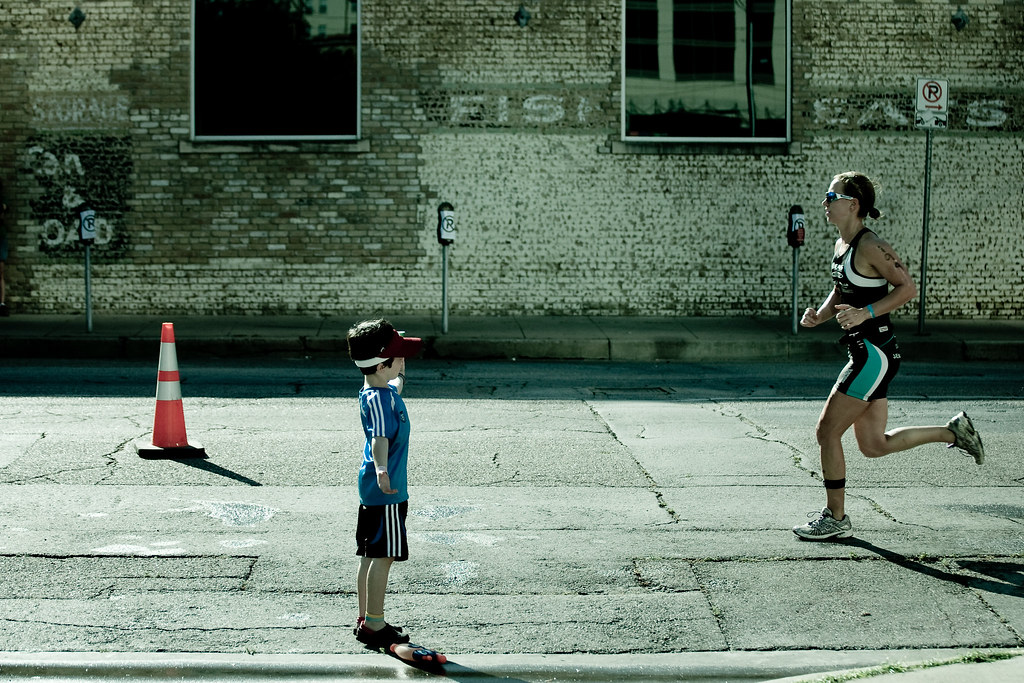
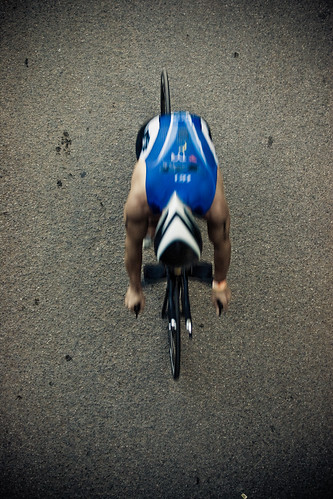
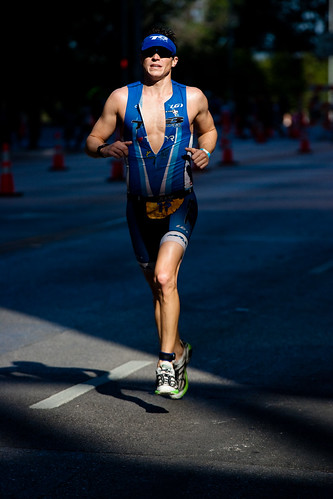
Spent some of yesterday morning shooting at the Capital of Texas Triathlon, in downtown Austin. I've been shooting this race off and on now for 8 years. For the last 5 years, I've used exactly the same equipment. It was interesting to see that I was starting to make some decent pictures, this time around. The first few years I was just happy to get a sharp picture. Then the next year, I was starting to get cleaner compositions, less stuff in the frame that I didn't want there, more sharp frames. This time around I seem to have learned enough to start paying more attention to the light and getting shots that actually start looking like what I wanted to achieve. Part of that is getting much more comfortable with the camera controls. Being able to react and change settings quickly and correctly, with only a few seconds to spare, really helped make the pictures I saw the potential for. I was also doing a better job of getting more interesting angles, shooting down from above, getting low, trying to do something more than just shots from eye level.

captex-62

Perhaps most effective was looking for interesting light and then exploiting it - finding places where the light was coming between buildings or bouncing around from glass and making shots that worked in those locations. All of this with the same gear I've been lugging around for half a decade. I imagine if I'd been switching cameras more often, or changing lenses, I'd have less familiarity with how they all work, I'd have to look at the controls and think more - be able to react less automatically. When things are changing quickly, that muscle memory really helps get the picture.

captex-84 captex-63 captex-56

Thursday, February 19, 2009

odd synchronisity for the day


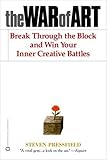
You know, Hitler wanted to be an artist. At eighteen he took his inheritance, seven hundred kronen, and moved to Vienna to live and study. He applied to the Academy of Fine Arts and later to the School of Architecture. Ever see one of his paintings? Neither have I. Resistance beat him. Call it overstatement but I'll say it anyway: it was easier for Hitler to start World War II than it was for him to face a blank square of canvas.

- The War of Art, Steven Pressfield

I posted 'resistance is futile' this morning, wondering about the twisting and turning people go through when faced with even fairly simple constraints. Today at lunchtime, I was going to eat alone and decided to pick up a copy of 'The War of Art' by Steven Pressfield, on the recommendation of Kirk Tuck, from his blog. Reading the book over lunch, I was amused to find out that Steven defines all the causes of procrastination, fear & doubt in art making as capital-R Resistance. A small coincidence, maybe, but maybe I'm on the right track. The book seems good so far. You can read the first few chapters, here.

Thursday, May 29, 2008

a wake up call

wake up call
A couple of things to read or listen to. Craig Tanner has updated his Myth of Talent talk and now much more strongly emphasises the need for a strong belief as motivation to developing talent. A lot of this seems to come down to visualising an expected outcome, then moving towards it. Listening to Craig's podcast brought me back to my own experience and how transforming the Next Step workshop proved to be, personally. Emotionally difficult, painful at times but it made a dramatic change to my approach to photography and life in general. Not as life-threatening or dramatic as Craig's own example but I can relate to the shift in belief and world view that he talks about and how it can change your outlook. The discussion on experts at the start of the podcast seems to lean heavily towards the concepts of thin slicing that are discussed in Malcolm Galdwell's book, Blink (The Power of Thinking Without Thinking). The idea that after much training, our unconscious mind can start making the decisions behind the scenes, enabling creativity and intuition, all via the mechanism of learned response and experience. As a result, you have whatever artistic gift or photographic experience that you have as a starting point, but conscious practice, hard work and repeated exposure to ideas and imagery will inform your future work, to a point where it becomes automatic and innate. It just takes hard work and lots of it. You need the passion to drive the hard work and the belief to keep going, but you can get there. The second, related piece is by Neil Gaiman on the ways to find a personal style. Neil is talking about writing style but I think it applies generally. The interesting question is about half way through this blog post, when someone asks how to stop copying other authors when they write; to avoid those influences and develop their own style. The simple answer is You write more or for us, you take more photographs. Eventually, style becomes what you can't help doing. It arrives after long enough practice - I think in part because of the ideas I mentioned earlier - thin slicing and intuition inform your style. It becomes how you see, or how you write or how you take pictures. The bottom line to Neil's post is something I've found myself and mentioned before. Honesty is what style is all about. Being true to your own interests or vision. Taking and sharing the pictures you want to take, not the things you think other people would be interested in. Make the pictures for yourself in a way that you like. Then you'll find your own style. Look inwards for the validation and enjoyment. Maybe other people will like the images, maybe they wont, but you'll have a lot more fun and satisfaction if you honestly follow your own creativity.

Friday, February 01, 2008

vassiliev

I found a link to the portraits of Alexei Vassiliev over on the Conscientious blog. I've drifted in and out of shooting totally blurred images and have recently started revisiting those ideas. Some of these portraits are really stunning. Worth a look. I think the stronger portraits are where the colour really makes the images striking - strong blues, vibrant reds. I've continually been fascinated with really shallow depth of field or even totally blurred images. I'm going to make more of an effort this year to shoot in this style and see where that goes. Uta Barth is another influence in this direction, for me. There's something about these forms of images, that often ask more questions than they answer that really engages me. I've been trying to move away from a totally literal style of photography, where everything is there for the viewer to grasp, quickly. Blur and out of focus regions tend to make me spend more time with an image, wondering about what might be there. Totally out of focus seems to take that to its logical conclusion.

Wednesday, October 24, 2007

the amanda project

the amanda project

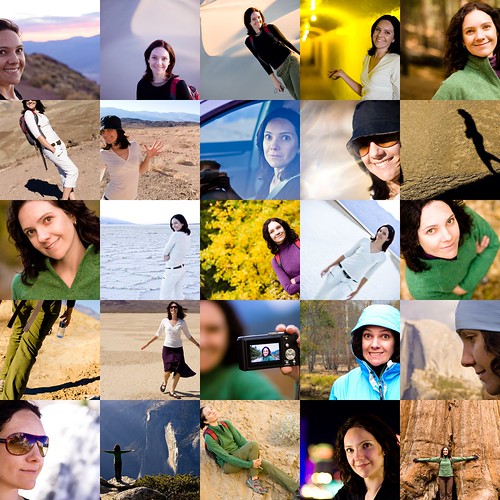
I've been talking a lot over the last year about the value of projects. A recent vacation to a few national parks seemed like the perfect opportunity to work on something with a consistent theme. For this trip, I picked my wife, Amanda, as the subject. The goal was to take a set of good pictures (around 20) of her that we were both happy with, in the various locations we found ourselves.
I decided to limit it technically too - I just took two lenses with me. I had a 50mm prime and an 85mm prime. The 50mm is one I haven't used much at all and the 85mm has been my go-to portrait lens for the last year. In fact, it's been my go-to lens for almost everything for the last year. I wanted to use the 50mm but put the 85mm in the bag as a fall back position. I tried to shake things up a bit by shooting almost everything with the 50mm. It turns out that about 90% of the shots I took were with the 50mm. Quite a turn around for me.
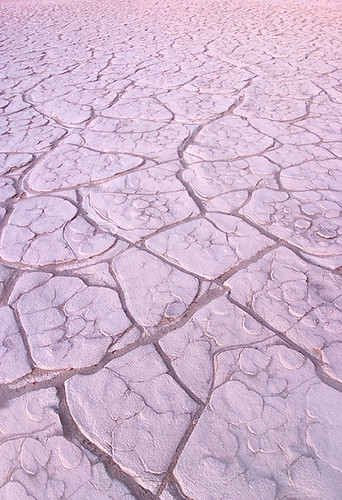
Now a 50mm and 85mm lens aren't exactly classic lens choices for a trip around national parks like Death Valley and Yosemite. Typically, you'd be thinking about some super wide lenses in the teens range and also a longer telephoto to abstract elements of the landscape. I decided to totally skip those options. I've been to Death Valley before and shot a lot of very wide scenics. I've never been to Yosemite but I've certainly seen a lot of classic landscapes from there. I wasn't going to compete with those images. I didn't even want to bother recreating various Ansel Adams views of the park, in worse light, or David Muench cloned images. Maybe I've finally gotten to the point where I have the courage to look for my own vision rather than copying others. Or I've switched to copying portrait photographers - I guess I'll find out over time. A few people suggested I was mad in taking this approach. That I'd spend the entire week regretting the decision or kicking myself, missing shots of a lifetime with the wrong lenses in my hand. Instead I took shots of my life and my times - I shot what matters to me. More valuable to me than pretty scenics of well-worn subjects. There's a joke that says half dome requires an extra stop of exposure now, than it did when Ansel Adams first took his shots of it, because so many photographers have sucked the light out of it. I contributed a bit, but with a slightly different motivation.
So the Amanda project was born, from an idea from Steve Barth with his excellent series featuring his wife. One week, 800 shots, lots of locations, dramatic changes in lighting, collaborations on clothing choices, hair. Hiking for miles, 4am starts, rain, bear sightings, climbing, driving : all in all a great time for both of us and I think a pretty good collection of images with a consistent theme.
I did cheat a touch on the only 50mm/85mm lens selection aspect - I took along a small, wide-angle, panoramic format point and shoot that I used a couple of times in this collection - but other than that, nearly all 50mm. I think there is one 85mm shot and that's the night image from Las Vegas. By the end of the week I was trying to find fresh ideas, use lighting, new focal lengths. I never actually felt I was missing out on shooting the grand landscapes by not having a wide angle lens. Yosemite is beautiful. Death Valley is amazing. We drank it all up, together, looked at the views, enjoyed the sunrises, sunsets and times in between. I did take a few landscapes and I'll start posting them up later, but I had a much more interesting project to work on, than scenery.
The project focus also pushed me beyond some of the standard portrait shots I'd have taken. I started looking for new angles, compared to how I've been shooting with the 85mm. Normally all I do is fairly tight head/shoulders portraits. The 50mm forced me to step back a bit. Shooting the same subject for an extended period forced me to look for new angles, new body positions, new ways to move. It got me thinking about posing a full person, even when they aren't posing as such, rather than just eliciting an expression. So again I found that pushing a subject area via an assigned project has helped me break new ground. I also pushed my lighting skills a bit, using room lights, rearranging furniture, etc. to light the night time Las Vegas shot. Something I probably wouldn't have done without this assignment in the back of my mind.
Hope you enjoy the results. We had a great time shooting them all. Click on the collage above to go to the set of images. Comments are very welcome.
In the comments, Kate asked: Of the shots in the project montage, were most with the 50mm? Of the 25 shown, 18 were taken with the 50mm lens. 2 were taken with the point and shoot DMC-LX1 and five were shot with the 85mm lens (old habits I guess).

Wednesday, October 10, 2007

Tybee island

Tybee island

I took a series of images out at Tybee island. I also tried to write about the experience. My first pass was: I GREW UP by the ocean. My favourite place to run is right on the surf line. Where the wet sand is firm enough not to slide and shift under your feet but dry enough not to splash and soak your shoes. The trick, and fun, of it is that the perfect equilibrium point never stays in the same place. Running, chasing the ocean is pure play - trying to find that flowing state of mind when your body moves to the right place just ahead of the tumbling waves. Get out of sync and the run is a haphazard journey of frantic dashes up the beach and back down after the retreating firm sand as the waves flow out. Get it right and everything flows effortlessly and your mind can soar. I ran for about half an hour along the beach at Tybee Island, relaxing from a stressful week. At first I was all over the place. Then everything clicked. I was just happy. Pure, simple joy.
That describes what I was doing, but in some ways I think the photography is more interesting for me. You can click on the big picture above to go to a set of my favourites. I'd been on a workshop for a week, pushing myself in ways I didn't really like to be pushed. Hadn't exercised for a few days. Was feeling really out of sorts. Think I'd slept for about two hours the night before too. I got to the beach and everyone else spread out with their cameras, set up their tripods and prepared to stake out the coming sunrise. It was a beautiful, silvery blue morning. I haven't been to the ocean for about 6 months, even though I grew up about 2 blocks away from the sea, in Scotland. I miss it. I miss running too - late nights, bars, no exercise. So running was the perfect escape that morning. But then I tried to take pictures that expressed how I felt. I love running. I switch off all the cascading thoughts and just be, where I am. I've talked before about how running connects me with my creativity. Shooting while running was similar. No thought of composition, other than where I was pointing the camera. I'm not looking through the lens, just gesturing in the vague direction I'm interested in. So some intention still, but not so controlled. I'd change settings intuitively, focus as I went along, shooting, running in and out of the surf. Some of the shots are really close to the water - when you realise they were shot at 17mm, perhaps it becomes clearer how close I was in some cases. Yet never too close. Or too far away. The lens just seemed to land right, time and time again. For once I actually felt the results captured something of what I was feeling. I find them beautiful. They connect me right back to that time and place on the beach, at Tybee. Every now and then I manage to let go and actually take some pictures. I need to keep working on that.

Monday, October 08, 2007

1% inspiration, 99% moving furniture

1% inspiration, 99% moving furniture

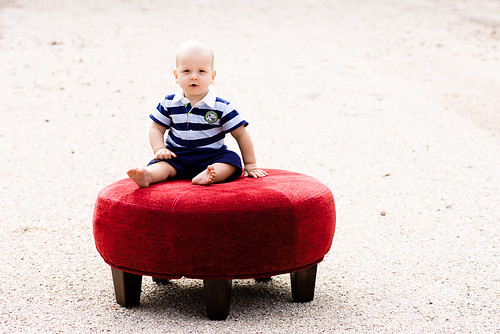
I like the Arnold Newman quote I have at the end of this blog. Good photography is 1% inspiration and 99% moving furniture. In this case, I took that to heart. The red ottoman seemed like such a great piece to build a shot around. But it just didn't stand out enough in the room. Outside, the (quiet!) road was covered in white crushed granite and seemed to be a perfect backdrop. The parents were thankfully on board with the idea too. (Really the street was very quiet!) We spent a bit of time clearing fallen leaves from the the background and set things up under a bright, cloudy sky which gave really soft, even light. I had the parents jumping around behind my head, rattling keys, clapping and generally trying to attract his attention. I like the mostly bemused expression in this one more than some of the happier shots we got - seems to suit the mood. One thing that's changed in the last year with my photography has been a bit more motivation to follow through on ideas. This is a shot that I might have thought about a year ago, but not even mentioned. It was a whole lot fun, quick, painless and certainly worth making the effort.

orange

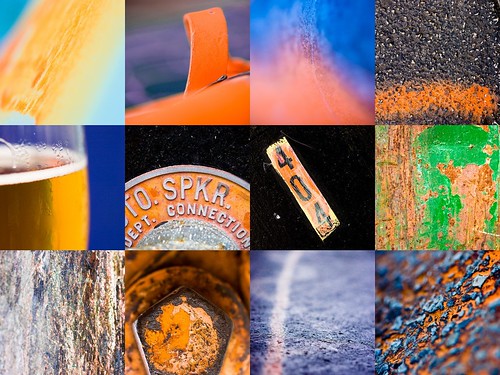
orangeShot these over a couple of hours walking around the 2nd and 6th street areas in Austin. Jeff was interested in going out shooting with our cameras, so we met up at Austin Java in the city hall. We agreed to go and shoot to a colour theme and set off looking. I was shooting orange, Jeff was looking for yellow. At first it can be hard to find anything. We both breezed along the whole of the second street district and only took a couple of shots. Couldn't find orange anywhere. Then suddenly it gets hard to stop seeing 'your colour' everywhere. Markings on the road. Splashes on some plastic bollards. The beer we stopped to enjoy along the way. I find this a really effective way to key in to a particular theme and then go shoot it. Otherwise I worry that there won't be anything to shoot in a given place or that I have to go somewhere special to find the right pictures. Truth is, they are everywhere, just waiting on you to notice them.
I also used to worry that if I was shooting on one theme, I'd be missing other shots, but I always find I'm much more productive and focused when shooting to a concept. I settle in, I explore subjects, I'm not wasting as much time searching for something to jump out at me, ready to shoot. Anyway, you don't have to be a slave to whatever concept you pick, it can just be a useful way in. Colours are a great concept, colour pairs, line, shapes, circles, squares, triangles, S-curves, textures, anything that gets you shooting and paying attention to the surroundings really helps. It can be a fun way to explore but also I find it teaches me a lot each time I do this, about what works, what I like, how I want to use things in my photography and that comes back when you aren't 'just' shooting a colour, later. Click the collage to jump to the whole set.

Tuesday, September 18, 2007

acceptance

acceptance

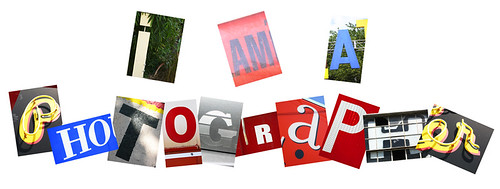
This was a hard thing for me to accept. I've always defined myself as an engineer. I might describe my photography as a hobby or something I do to pass the time, but I'd shy away from such a bold statement. I took pictures for fun, I spent a lot of money and time on camera gear and working with images, but I'd always avoid saying this. But here it is. I am a photographer. I see photographically. I frame images in my mind, even without a camera. Colours and colour pairs jump out at me as I go through my normal day. I can see the difference and intersections of indoor and outdoor light and can see the difference in colour temperature. I take & make pictures more than I collect camera gear. Ideas for photographs or concepts for projects assail me constantly. I am a photographer. I noticed in Savannah when I asked someone if I could take their picture that I'd bring a long, boring story along with me to justify the process. I'm on a workshop, I'm taking a class, no I'm not a photographer, it's just a hobby, blah, blah, blah. Then somewhere along the way, someone said this to me and it suddenly crystallized and became easy. I accepted the truth. I am a photographer. I'm a lot of things. No one term or label can or has to define who you are. I'm a husband, a son, a triathlete, an engineer, a consultant. I'm also a photographer.

Wednesday, September 12, 2007

karen

karen

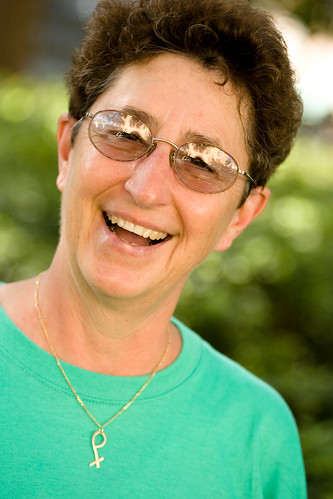
A new good friend of mine, Karen. We were paired up on an assignment in one of the squares in Savannah. It turned into a walk around to look at the different types of light quality we could find. Walking along, using each other as models, we talked about what light was hitting us and looked for ways to find it. The square had one large orange building in full sunlight and I've used that here has a huge orange reflector to warm Karen's skin. I'd use the back of my hand as a guide, seeing how the reflected light changed as I turned my fist around, watching it hit my forearm as I moved my arm in the space. After a few minutes of carefully paying attention I started noticing that I could feel the light hitting my face, turning half on I could really feel the light falling across my skin and how the ratios changed. Moving through the tree shaded area I could tell when the sun behind me was hitting my head, providing a back or accent hair light, or the warmth bouncing from a wall. Just taking the time to look at light was making me more sensitive to it. Karen also took the funniest set of self-portraits I saw in the whole workshop. Great imagination and hysterically funny to see. Inspiring.

Monday, September 10, 2007

coming home

Abbazia di Sant'Antimo

Over the next few weeks I'm going to be posting images from the Next Step workshop that I've just finished in Savannah. There are a couple posted already. In some small part, I'm going to try and explain the things I learned or found out upon the workshop. As Paul mentioned in an earlier comment, it was an amazing and very challenging workshop. I'm not sure I can do justice to the whole thing and some of it is kept under wraps to keep it special for the next round of participants. But then I happened across this quote:
A hero ventures forth from the world of common day into a region of supernatural wonder: fabulous forces are there encountered and a decisive victory is won: the hero comes back from this mysterious adventure with the power to bestow boons on his fellow man.
Sounds about right.

Saturday, September 08, 2007

next step

next step

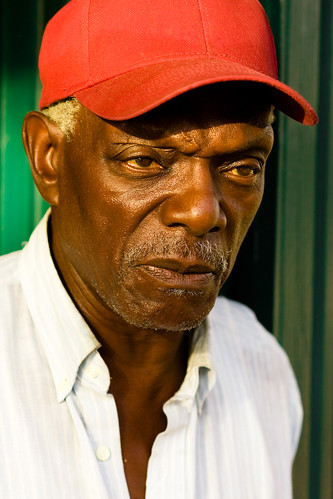
wow. What a workshop experience. Emotional rollercoaster of a time. Such a great, talented, creative and inspirational group of photographers and Savannah is such a beautiful place too. I'll write more about the workshop when I get home but wanted to share one of many portraits I've taken out here. Such a great week. Meet Harold. I was initially drawn to his bright red hat. We chatted a bit about Jazz and his love of B. B. King. Luckily enough he was happy to let me take his picture. I asked him to step over to just in front of this green awning, in the full sunlight. The quite harsh, direct light really makes the colours pop and his skin glow. I shot a few more as we talked then tried a couple with a similar background in open shade - the colours and mood of the shot in shade just don't work for me as well.

Sunday, April 22, 2007

You can quit, and they won't care, but you'll always know.

He's nervous, but on the surface he looks calm and ready
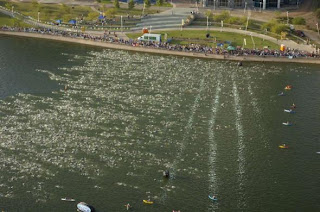
Right here, right now... Fatboy Slim boomed out across the water. 2,000 heads bobbed in the early morning sunlight, ready to get started. After months of training we are right here, right now. The canon fires and the water erupts into a foam of arms and legs. I'm right there in the middle of it; Tarzan swimming, kicking, punching, breathing and surviving. Ironman Arizona 2007 has started. It is going to be a long day.

The swim pretty quickly settled down. I'd heard all the stories of black eyes, goggles getting ripped off and kicks to the head but it didn't feel any worse than a typical age group wave start. The first few hundred meters were a crazy mess of bodies but then it calmed down for me and I settled into a comfortably easy rhythm. No reason to push it yet so I just warmed up slowly. Stroke. Roll. Breathe. Stroke. Roll. Breathe. My hip flexor had been starting to tweak over the last few days of taper and I could feel it when I kicked too hard - not a good sign so early on - but I just got on with it. The turn-around seemed a long way past the far bridge but soon enough I was coming back towards the Mill Avenue bridge and I'd finished the swim. I was pretty happy to have swam 1hr 12min for 2.4 miles - right around where I thought I'd be.
The wet suit strippers did their magic and I was off to transition, running through the throng of cheering supporters. I call out my number and someone hands me my bag. Quickly I find myself inside the frantic mess of the transition tent. I work my way to a quieter corner and find a chair to sit on, start going through my bag. Sunscreen, bike shorts, top, sunglasses, shoes and helmet on and I'm ready to go back out to the sunlight and noise. I step out of the tent and get more sunscreen applied and then run in my bike shoes to get my bike. Someone yells my number through a loud hailer and a volunteer gets my bike for me. This is a full service event! We have it easy - all we have to do is swim, bike & run for a while - someone else is always dealing with the logistics. I jump on my bike and ride out to the course. I hear Amy Ewert cheering for me right as I leave on the bike - so many people out here that I know, such great support.

Out on the bike course I settle in for the long haul. I'm expecting to take a bit over 6 hours but I want to start out easy and not push too hard. The temptation is certainly there. The bad thing about being a faster than average swimmer is that most of the fast bikers are behind you and spend the whole ride passing you. But that's just a case of keeping the ego in check and racing your own race. So people pass me and I spin along at 100 rpms, feeling okay, starting to eat, drinking a bit and feeling great. I get to the turn around point and I'm still feeling like I'm flying easily. Then I turn around and find out why. For some reason I never notice a strong breeze when it is helping me - but you sure notice it when it is right in your face! 20 mph sustained winds with gusts up to 35 mph had really helped me on the first half, but not on the way back! I just struggled along with everyone else, finishing the first loop and still feeling great. I'd trained for this, a bit of wind wasn't too much of a worry. At one point a helicopter appeared over a mesa, from out of nowhere. One minute I'm in a quiet desert, then there's the roar of the chopper. Flying low, following the leaders, it was just another indication that this wasn't just another triathlon - this was the big one and I was right in the middle of it.

I was playin in the beginnin, the mood all changed
About 3 hours into the ride I realised that I hadn't needed to pee at any point. My stomach was feeling bloated which for some reason I'd taken as meaning I was drinking too much - but the problem was exactly the opposite - I was getting way behind on my hydration. Luckily I realised that, along with how much slower I was suddenly going and I really started drinking a whole lot more. Nuun, electrolytes, 2 bottles of water every 10 miles. But the damage had been done by that point. I was getting slower and slower but feeling like I was trying harder and harder. Not much I could do about it but keep drinking. and drinking. and drinking. Soon I was stopping at every water stop to pee, but still drinking and trying to get back on top of things. The end of the second loop was windier again, dust clouds were starting to obscure the course and the tumbleweeds were on the march. I saw a few blow across the course, 4 feet wide and moving fast. Some poor guy blocked one for me and got knocked off his bike for his trouble. Somehow I made it back through town and headed on my third bike loop.
It only grows harder, only grows hotter
This time around it was getting really windy. Close to the start of the loop, 5 metal signs with sandbags slid across the course towards me, then crashed down a few feet away. Another gust pushed me sideways across an entire lane, before I could even react. Things were starting to get interesting! I rode with the wind at my back for the next 15 miles, letting it push me along, still trying to get on top of my hydration as the day got hotter. Just after the turn around I passed my friend Laurie Curry and said 'Can you believe it, we are doing an Ironman!' she grinned back at me and rode on. It was great to see people I'd trained with doing so well - all through the bike I saw training partners plugging away, moving through the field. We'd cheer for each other and it really helped keep the focus and motivation going on a tough day.

The ride back to transition didn't seem too bad, even though at one point I was struggling to go at 14 mph - downhill. But eventually I made it back, through the cheering crowds, off the bike at the dismount line without falling and my bike was whisked away. One hundred and twelve miles done, 6 hours and 53 minutes later I hobbled through transition (nothing so grand as running this time) and grabbed my next bag. I saw Chris Sellers helping out at the transition tent and he took charge and got me organised. Getting the gear out of my bag, setting me up to get running. Once again out of the tent and off to the run course - just a marathon to go.

So here I go is my shot. Feet fail me not cuz maybe the only opportunity that I got
Twenty six point two miles to go. I checked my watch and realised I had nine hours before the course was closed. I could walk. I could probably even crawl it in that time. I just had to hold it together and I would finish. I started trying to run. The hip flexor that had been sore was complaining more loudly now. I couldn't do much more than walk. So I decided not to push it, at least for the first mile. Keep walking, keep moving. I'd run a bit when it was flat, walk up the slopes, jog the downhills and just try and not hurt myself any more. I was taking iced water at every stop, still trying to get the hydration back on track but I was still feeling tired after the bike. About a mile in I set my watch to beep every minute. Run a minute. Walk a minute. Run a minute. Walk a minute. I'd keep making this deal with myself, keep it going. Your mind starts playing strange tricks on days like this. I'd be running along (slowly) thinking 'okay, nothing hurts, I feel good, I don't feel tired, I can keep running this pace, keep it going'. Then I'd realise I was walking. No good reason, but I couldn't make myself run. Obviously my body is more sane than my mind. But over time, my mind won out. I'd run more, walk less. I kept drinking, filling my bottle with Gatorade which perked me up some more. I'd brought 10 Gu shots with me for food. I tried one and almost threw it up - that wasn't going to work! So I switched to plan G (I'd already used up plan B on the swim, plan C, D, E & F on the bike. Ironman is about dealing with things as they happen - so have lots of plans and stick to them. Any of them) and started scavenging on the course. Cookies were okay. Grapes, not so good. Jolly ranchers were fantastic! Anything and everything I could keep down with calories in them. Nine Gu packs bounced along on my back for the rest of the race, unwanted and ignored.

I saw my brother at the end of the first loop on the run, 9 miles in to the marathon. He'd flown out from Scotland for work and decided to drop by to watch Amanda & I. He said later he didn't quite realise the scope of what I was trying to do, until he got there. It was great to see him and I picked it up and ran some more.

You get a couple of race numbers, one with your first name and one with your surname. I'd decided to wear my first name and it was great. People would call out your name and lie to you at any opportunity. 'Looking good, Gordon' 'Looking strong, Gordon' 'Looking fast, Gordon' all lies, but certainly appreciated! I saw Amanda as she came back from her second loop. We stopped and hugged and then she was off - looking good, looking strong, looking fast. Some time on the second loop the chicken broth appeared at the water stops and I tried it. Chicken soup has never tasted as good! I'm not sure it goes too well with Gatorade, but I drank them along side for the next 13 miles.

Look, if you had one shot, or one opportunity
To seize everything you ever wanted-One moment
Would you capture it or just let it slip?
Somehow, someway I made it back to the transition area and headed out on my last lap. Looking at my watch I realised that if I ran this loop I could finish just under 14 hours. It was possible, but it would require some work. The previous two loops had taken me more than 1 hour and 50 minutes per loop, but I needed to do this one in about 1 hour and 40 minutes. Certainly possible with fresh legs. But now ? So I started running. Really running. Well, shuffling faster than I had been. It was starting to get dark by this point, the sun had set on the lonely Western stretch of my second loop. The field had thinned out as many people had finished, though some hardy souls were still just heading out on their second loop, heading for 16+ hour finishes or DNFs. Each time I passed someone, I pushed a bit faster trying to get to the line under 14. I focused on that idea and picked it up. I remembered an answer Peter Reid had given when asked about the deep, insightful thoughts he has during his Ironman-winning marathon runs. He said all he does is count his steps. So I counted my steps. 1... One foot after the other, 2... focusing on my cadence, 3... tapping out a rhythm with my feet, 4... running through the falling light. I was handed a glow stick to light me up and I wrapped it around my arm. I kept counting my steps. Running now, feeling finally good. One hundred and thirty miles after that swim start, I felt I'd finally warmed up and was flying. I was going to finish! I kept passing people. People who looked lost, walking almost aimlessly. Sitting on the kerb, head in hands. I passed people throwing up. I passed people walking. I kept counting my steps. I passed Jim Opre, that I'd trained with, and traded some lies with him 'Looking strong, Gordon', 'Looking good, Jim'. Finally another competitor caught me and passed me on the windiest stretch of the course. I fell in step behind him and drafted for all I was worth. We went back and forth like that for the final 4 miles.

He better go capture this moment and hope it don't pass him
Close to the finish now, I saw a big hat that I recognised. Ralph Stanley was up ahead and we congratulated each other - only a mile to go. I was going to finish! I tried to pick it up a bit more and run through to the finish line. Just before the final hill I caught up with Jim Curry, about to start his final loop. He had a long way to go but plenty of time to get there. I ran up onto the bridge and across down to the finish line. One last time past the best support you could hope for, from Nancy & Karen. I could hear the announcer for the people finishing just in front of me, then suddenly I was out of the darkness and quiet and into the noise and light of the finish shoot. I high-fived some spectators and ran for the line. I could vaguely hear 'Gordon McGregor - You are an Ironman!' but somehow I can't remember much at all about finishing. Just a huge sense of relief! Chris Sellers was again at the finish and it was great to see a friendly face. He caught me and guided me through the finish, t-shirt, medal and bake-o-foil blanket on. I looked back over my shoulder and saw 13:53. I'd made it well under the 14 hours. My last loop was 1hr 42, 14 minutes faster than the previous loop. What sort of idiot negative splits the marathon in an Ironman ? Then I was out to see my brother and to congratulate all the other great T3 athletes that finished.

32 of us started. 32 of us finished. A huge achievement on a day when over 10% of those who started dropped out. 3000 people signed up for the race. Of those, 2461 were still registered by race week and issued with numbers. 2068 actually got into the water on the Sunday, to start. 2066 finished the swim. 1860 finished the whole race before the 17 hour cut-off. 13 of the 43 professionals in the race dropped out. I finished and everyone from T3 finished too. What a day!
SWIM BIKE RUN OVERALL POSITION
1:12:35 6:53:35 5:30:32 13:52:34 1224
So here I am writing this, almost exactly a week later. This time, seven days ago, I'd be enjoying the beautiful blue lake and lights of the bridge in the gathering dark. The water that had been so murky and brown in the morning was a deep, tranquil blue, reflecting the twilight sky. It was a peaceful moment in the middle of such a hectic day. Made it all worthwhile. With the lights strung across the bridge and the desert sky above, I counted my steps and realised how lucky I was to be out there, doing this race, finding out what I can achieve when I just put my mind to it. Ironman isn't so much about the physical achievement, it's about the commitment. Committing to a goal that's bigger than you. Doing the training. Riding in the rain and thunder for six hours to Shiner, Texas. Running the 3M half marathon from the finish to the start line, then back again from start to finish. Freezing on a long, wet, cold ride out Fitzhugh Rd but finishing it strong. Swimming when the deck had ice forming on it. Getting out of bed on those cold, wet days. 3 hour rides on the trainer, watching Indiana Jones to stop us going insane. Lap after lap of Barton Springs. Running the damn dam loop on Town Lake one more time, then once more again. 100 mile rides out in Manor, getting chased by dogs and almost throwing up for messing up the nutrition. Finishing 20 mile runs that I wasn't even sure I could start. Turning up, day after day, month after month. Being consistent and being out there with Amanda. I'd never have finished without her and without all the other T3'ers that got us through. You can read Amanda's view of the race. So what's next ? A half-ironman in St Croix in 2008, maybe Ironman New Zealand in 2009. Lots of options. The first one is the hardest!

You can do anything you set your mind to
- Lose Yourself. Eminem

Sunday, April 08, 2007

Ironman Arizona 2007

140.6 miles
226.3 km
That's about the distance from Glasgow to Aberdeen. Somehow Amanda and I plan on doing that distance, under our own steam, next Sunday. We start off with a 2.4 mile swim - about the distance across the Clyde, from Cardross to Greenock, then we hop on our bikes and ride for 112 miles - from Glasgow, that would get you to Fort William. Then, after that brisk 7 hour warm up, we do a quick 26.2 mile marathon on foot to round out the race. In one day. Without getting any sleep. Us and 2,400 other people. But we are ready.
This all started about a year ago - I got an email from Amanda: Topic: ironman AZ Date: 05/02/2006 From: "McGregor Amanda-A14120" To: "Gordon McGregor" registration is up!!!!!! April 15th 2007... Let's do it!!!!!!!
My first response was to tell her she was mad. So was my second and third responses. But after a couple of days, she wore me down (or actually, just signed me up anyway!) So we started on this crazy journey to finish one of the hardest races around. We joined a training group in Austin, called T3 and made a load of new friends. There will be 30 of us traveling out to Arizona to race together, which adds to the shared insanity. I took about 6 months just trying to get fit enough to start the training, dropped 25lbs and mentally got myself to a point where it didn't seem such a ridiculous goal. Then we started the training. 20+ mile long runs in the cold and wet. 6 hours freezing on a bike. Swimming in the dark and cold. Amanda kept better track than I did, but we've swam over 50 miles, rode over 2000 miles and ran 450 miles training since September. Oh, we are ready.
So we fly out to Tempe on Wednesday evening to start the final stages of this long journey. This is the time to really enjoy : the race. The training was hard, the race is going to be hard, but nothing is going to stop us finishing. Someone will need to drag me off the course. Plenty can go wrong, but I'm not stopping. 7am next Sunday morning, the canon fires and we take off in the mass swim start in Tempe town lake. 2000+ bodies swimming along side each other, punching, kicking, pushing and jostling for position. I can't wait. We are ready!

The race starts at 7am. Swim should be a little over an hour, maybe 1:15, so we should be on our bikes some time around 8:30am, then spending 6 or more hours riding around Tempe. If things go well, we should be starting the run somewhere before 3pm, right when things will be getting hot! Then the marathon. My best time ever was over 5 hours, but that was a horrible experience! I'm hoping for a slightly better marathon this time around, but all things considered, I think we should be finishing close to 8pm around the 13 hour mark. We have 17 hours to finish, before they close the course and tell us to go home, so I think I have a good chance of getting there. I'm ready. Just to give some frame of reference for friends & family around the world, here's the times. I'm not claiming to be hitting any of these marks though! This is just a rough guide. My race number is 694. Amanda is 2114. You can track us through the day at www.ironmanlive.com and see how we are doing. Though, if we don't appear, don't panic - it has been somewhat flaky in the past! There's more race details at www.ironmanarizona.com. Wish us luck! For Amanda's view on all this, check her blog.
p.s., Sorry for the lack of photo related blogging recently, maybe this explains in some small way, why.

Monday, March 19, 2007

Finding the fun

Some days just remind me that I love taking pictures. It has been a couple of weeks since I picked up my camera, due to work, training, lack of motivation and all the things discussed in my last blog post. But at the weekend I met up with some of my friends from The Radiant Vista that were in town to do their inspirational photography tour. The first night we went out for dinner and everyone but me had a camera with them - shooting things, being silly, having fun. The next night out I took my camera too. I shot a few hundred, blurry, out of focus, silly lensbaby shots. Played around with the star apertures, didn't worry too much about getting things sharp - in fact for the best stars it pays to have everything out of focus. The results may or may not be that great - I haven't even really looked at them yet - but I had such a blast just shooting and composing and seeing the world through a lens again. I always forget how much I can lose myself behind a camera and just let go. I love the sense of calm and focus that I get when I'm working well with a camera. Letting go yet being in control at the same time, trying to balance the creative and the controlling voices in my head - the ones that want everything sharp with the ones that want to swing the camera around and see what happens. When the pictures work it is a huge thrill, but the process of shooting is where the real fun is at for me. The process changes if I'm on my own or if I'm shooting alongside other photographers, or shooting people as the subject. Shooting with people is a great way to make a connection, talking to them if they are in the shots, sharing the fun of goofing off and making interesting pictures if they have cameras. Shooting alone is a much more slow and calming process for me, that relaxes and energises. Shooting with people seems much higher energy when it works - perhaps being more draining but also often leading to more exciting results. I usually feel exhausted if I shoot with other photographers but I find myself riffing on ideas that I don't think I'd have purely on my own. I get a kick out of both styles, the loaner and working with others. There is much to be said for both ways to approach photography and I think if you only find yourself working in one way or the other that you owe it to your picture taking to push off in the other direction some times. Moving out of your comfort zone is a great way to surprise yourself and find new avenues to explore.

Wednesday, March 14, 2007

Dry Spell

Dry Spell

I've been going through something of a photographic dry spell recently. I had a very productive flurry of activity towards the end of last year and the first couple of months of 2007. I made a lot of progress on shooting portraits, started to discover the fun of off-camera lighting and generally learned a lot and took a lot of pictures. Some of them were published and others feature amongst some of my favourites that I've ever taken. Yet here I am in mid March and I haven't really taken any pictures this month at all. Somewhere along the line I ran out of steam. Sure I'm training for a race that is only a few weeks away and that is starting to impinge on my thoughts. Yes, the training takes up a lot of my time, as well as mental & physical energy. But I've been training for this since March last year and I managed to fit a whole lot of photography in and around it for the last three months. So that can't be it. I've been working more hours at my job too, but I was working hard over those other three months as well. So where is the procrastination coming from ? It isn't that I have a lack of ideas. There are at least three shots in my head right now that I would love to go and shoot. If I start thinking about it I can come up with half a dozen more just as I'm typing. These aren't even half-formed - I can visualise how I want them to work out and what I need to make them happen. They are interesting to me, would push me in some new directions and I think would be rewarding to do. So it isn't a lack of ideas. The thing that is slightly different from before is that all of those ideas involve other people as part of the scene or as subjects. Suddenly it isn't just my schedule that has to line up, but I need to organise someone else and time it with them and the available lighting. But even that isn't so hard to do. I feel that I'd be imposing myself on them. I know I have more enthusiasm to take these pictures than most people have to be in them. Though I think looking more inwardly, it is really a fear that the pictures just wouldn't be good enough and that I'd be wasting someone's time. But I've dealt with that with all the previous shoots I've done recently too. The thing that has changed is that I was keeping a private creative journal - just a private blog that I posted about things I wanted to do and what I needed to do them. This log seemed to push me onwards to work out the next step along the way, each day. I've let that daily journal falter and I've noticed a marked downturn in how much photography I'm doing as a result. That seems to be the key thing that has changed and that I'm going to try to return to over the next few weeks. Maybe it was all the rain last night that made me realise this. But really, it was writing this blog post - at the start of writing I wasn't sure what I thought the problem was, but now five paragraphs later, I think I've worked through the issues in my head. That's just what the personal journal helps me do too - I just start writing about things I want to sort out and I mentally order and process the issues as I go along.

Monday, March 05, 2007

Laguna Gloria

Laguna Gloria

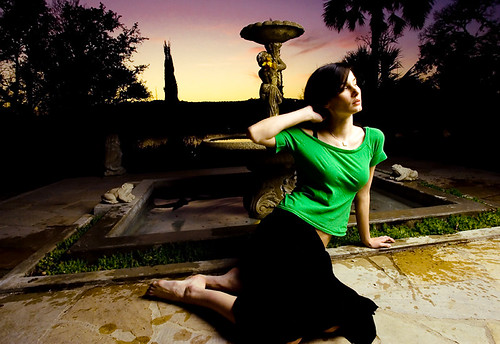
I've just finished a 5 week portrait class at the Austin Museum of Art. The shot of Jennifer above was taken on the final session as an experiment with mixing studio strobes and outdoor ambient light. We were fighting against the setting sun to set this up while there was still some colour in the sky. I'm standing with a 6ft square softbox quite close to the model, on the camera right, shooting in manual mode with the aperture around f8 and the shutter set slow enough to pick up some of the colour in the sky. I'm actually triggering the strobe with a 580EX on camera, set at 1/128th power and pointing in the general direction of a peanut slave that is connected into the strobe power box. There's another smaller strobe pointing at the fountain to light it, set about a stop lower power than the main light. I like the composition of this particular shot because of all the acute angles, in the angled fountain, her legs, her arms and all through the shot. The side lighting gives some drama and mixing in the sky colour really makes the shot pop. This was really set up as a lighting test, there were another 5 people shooting at the same time as me, so it ended up as a slightly strange experience. Nobody was really very comfortable talking to Jennifer, giving her suggestions on how to pose or generally working with her to get good results, so it all came off as a bit artificial. I think some were maybe too shy to direct and others didn't want to be pushy when others were trying to get the shots too. I much prefer working one on one, with less of an audience of people around - I think that's mainly a lack of confidence but also I'm just not really sure what changes I want to make or what suggestions to make to improve the shots - something I want to work on more this year, by studying successful portraits and getting a better idea on how I want to visually compose the space. The portrait class was a good experience for me - to spend an evening a week on just this one subject, sharing my work with a dozen other people and getting to play around with some studio strobes. It also introduced me to some new photographers and made me spend some more time in the library studying some of the history of portrait photography, Irving Penn, Richard Avedon and so on. I picked up some interesting ideas and got some more experience with lighting. A big improvement on trying to discuss this sort of thing on-line. It is always much more effective to just get in there and see how it all works. The theory is all well and good but the actual practice of moving the lights around and seeing the effect is much more educational for me. My main regret was that the class was only 5 weeks. As a group we were just starting to get more comfortable with each other and start sharing more interesting ideas and suddenly it was all over. I'm hoping I can keep in touch with some of the people that were in the class or even shoot with them in the future.

Tuesday, February 06, 2007

Visual language

Cross

A recent lenswork podcast brought to mind the idea of visual language and how we read photographs. Brooks expresses an interest in information theory but really seems to be considering the shared components of visual language. The visual words & phrases we all perhaps instinctively understand - a smile, crying.
For me, the key concept in information theory has been the measure of surprise, or entropy in a message. The canonical example is the two sentences, 'dog bites man' and 'man bites dog'. The second sentence is more surprising, even though it has the same words and number of letters as the first case. But if they were newspaper headlines, the second would grab your attention - it carries more information because it has more surprise. As a result it has higher entropy in an information theoretic sense of the term. This might be analogous to the difference between images with high initial impact and those that are quieter. Lots of colour, contrast, dramatic light and unusual subjects tend to characterise images with high impact and lots of visual surprise or entropy. Calmer palettes and light might lead to less surprising content. However, what interests me more is visual language and when applied to photography, two aspects. How to read & how to write visually. First I'd like to learn how people read images. I've heard mention that Westerners read photographs in the same way we read normally. Starting at the top left and working our way back and forth to the bottom right. If that's true - how can we use it ? Basic guidelines talk about rule of thirds and power points on those intersections - but if we scan a picture from top left to bottom right, does it then mean that each of those 4 places on a picture have different impact ? I think so. You can see that this is true by flipping rotating and mirroring images and notice how it changes the feel of them. This idea also can help with the placement of leading lines or other compositional elements, to change the way the picture is scanned. Other features such as the brightest area of the image or areas of highest contrast will also grab our eye, just like a surprising headline will make your eye jump ahead. So if Western cultures read images the same way that we read text, is that also true for other cultures that read top to bottom, or right to left ? Are images and composition significantly or subtly different in those cultures as a result ? Is the way we scan an image something more instinctual than that, or really driven by our education ? Secondly, knowing about these concepts and incorporating them consciously into your images can really improve the overall feel. Eventually it becomes more of an unconscious act that becomes part of your visual way of writing. I'd love to learn more about the way we scan or read images so if anyone has good pointers or references, please leave me a comment. But that just touches on the layout on the page. What you are saying is equally or more important than how you say it. There are certainly some universal visual phrases that you can use - sunsets, a smile, a baby crying. Everyone that looks at the picture understands those symbols straight away. But there are also more complex phrases, that are culturally relevant. These become harder to read if you aren't part of that culture. As an example, consider the use of colour. Red in some cultures for weddings, white in others. Or red for Communism. Black & orange symbolise Hallowe'en. In China, white is considered the colour associated with funerals. White hooded robes in some cultures are a sign of hatred, in others the robes of very religious, pious men. A cross. A flag. All powerful short-hand for specific ideas. Using these stronger symbols can be very open to subjective interpretation - the viewer may well see and understand things in a very different way to the photographer. Brooks mentioned Robert Franks series 'The Americans'. I checked that book out of the library a couple of years ago and was singularly unimpressed. The images didn't mean much to me. Didn't make much sense - I couldn't understand all the praise heaped on that collection. It wasn't until a few weeks ago, while listening to a Jeff Curto lecture, where he described one of the images, that I started to understand the symbols and perhaps the power and significance of Franks other images. There is one image, in a diner, with a blown out window, a TV on, and nobody in the room. Curto describes the cultural fear of a nuclear holocaust, symbolised in the white window. He also explains that the TV is showing a famous at the time TV evangelist. Symbolising the preaching of religion and morals in the US - but nobody is listening. All of these symbols and ideas encapsulated in that image, but none of them registered with me. I didn't understand the nuclear zeitgeist or recognise the symbolic preacher. So the picture passed right over my head. Symbols are powerful phrases in photography, but only when they connect with the viewer who gets what you are saying. I also wonder if there is a visual equivalent to sentence construction. Some languages such as German tend to have the verb at the end. English has a different structure. Is this sort of re-arranging of the phrases and basic building blocks present in visual language too ? More importantly, can these ideas be used to change how you compose a picture to give more or less impact and in the end, to communicate ideas more effectively ? To do that, there's perhaps the even harder first step of working out what you want to say - what does the subject or scene in front of you make you feel and want to communicate ? Only then can you start thinking about how you want to say it.

Monday, January 22, 2007

What's your favourite f-stop ?

The question in the title started out as a joke question sometimes asked of photographers in interviews. It seems initially stupid - after all, we can use whatever f-stop we like and tend to change it for each shot. But after thinking about it a bit, I realised it is also a fairly defining component of a photographer's style.
Sure I shoot landscapes with deep depth of field and try to pick the most appropriate f-stop for whatever I'm shooting. Or I'll pick f8 when I don't care but want to make good use of my lens. Or I'll shoot a wide open aperture when I want a lot of blur or low light, stopped way down when I want the most possible depth of field.
But all things being equal, I tend to gravitate to shooting wide open or with a very shallow depth of field. My default choice, if I don't think of a good reason to change it, is close to wide open. This lets me be lazy - I don't need a tripod so much. It also lets me shoot a lot with available light - I can hand hold indoors. I also tend to select very fast lenses, 50mm f1.4, 85mm f1.8 and shoot those wide open, recently. My choice of f-stop influences my choice of lenses and how I'm using them.
My f-stop of choice frees me from the digital bane of existence, sensor dust. As I prefer to shoot at the wide open end of the scale, sensor dust doesn't feature in many of my shots. It also gives my portraits a consistently subject oriented feel. I'm not shooting the environment, any that is there is very quickly relegated to background colour and texture by my choice of f-stop.
Being aware of this bias in how I approach shooting is hopefully going to open my eyes to other ways to approach the same scene, maybe by trying to shoot some things with other f-stops on occasion, even when the situation doesn't demand it.

Wednesday, December 27, 2006

Ways forward

I’d sent my meandering thoughts on my photography and where I’m going to a few people that I’ve corresponded with over the last year. Paul Butzi was kind enough to take the time to respond and let me share his thoughts with the world. I think Paul sums up a lot of the things I've been struggling with pretty succinctly, so I'm just going to put his response here, in the hope that it can help others.

It seems to me that what you're asking, really, is "now that I've built a skill base, and I have a process in place for working on craft, where do I go from here?"

In my mind, things always tend to play out along the same lines photographers seem to build skills up to a certain point, and then either stall (and continue making what I call onesies - good or great photos that are unrelated thematically), or else they seem to gravitate to working in a more extended project format. It seems like the ability to work in a focused way on projects is the skill that seems to vault photographers up over the stall point that I think you're hitting.

In the book "On being a photographer', by Bill Jay & David Hurn, they talk about working on projects being about developing a plan and working to the plan, having a shot list, etc. I'm sure that's a help to commercially oriented photographers, but for the rest of us, it's of little use. When I work on a project, it seems to be quite a bit less cohesive and planned, and the project often takes unexpected turns in ways I hadn't imagined when I started out. I know other photographers who have little rituals that they use, patterns they use to get engaged with the project in the large. It seems to be different for everyone, and so it seems like each of us has to work it out for him/herself.

The essential ingredient seems to be that the project has to be something about which you care. If you don't care a lot, it will just peter out and die.

So I'd suggest that you pick a subject that you care about, and photograph like crazy. Look at the images you get, and make prints, and put them up where you'll see them all the time. Spend some time thinking about them, about what they say and what ideas you get from the ones you've done, and what you'd like to do next. If you have other photographers nearby, get together with them and show them the prints and listen carefully to what they say - not so much about the individual images so much as the whole body of photos. Often the telling comments are the ones that they just let slip in a casual way - those comments are often about the overall direction they see things taking.

There's a weird thing - the best projects seem to evolve a lot and become addictive, and seem to start to embody things beyond just what's being photographed.