Showing posts with label artists. Show all posts

Saturday, September 05, 2009

lessons and new ideas
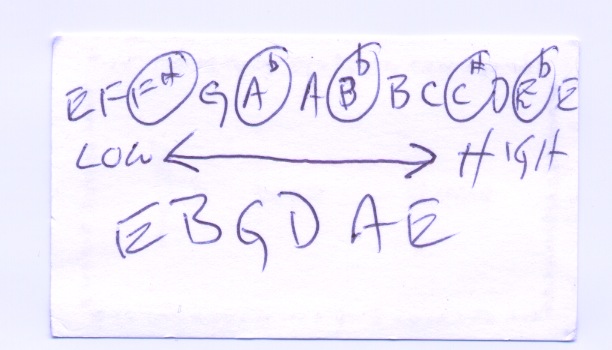
first guitar lesson

Lots of things been going on in the last month or so. I finished up the images from the Ironman triathlon project. Well - I finished taking the pictures. I've done the basic editing too, but haven't really looked at them all as a set. Part of the delay has been I've wanted to get a bit of distance from them, but also that I wasn't quite sure what I wanted to do with them. Initially I was shooting them with the idea that there would be a book, and that may still happen. Then I've been kicking around the idea of a small gallery show or end of season party and show, but that would probably need some sponsorship to pay for several larger prints. I did get one image accepted in the Texas Photo international competition opening next weekend, which is a thrill, but still not really the focus of the project. I'd also been contemplating putting something together for the SlideLuck PotShow coming up here in November.

Things fell in to place a bit more on Thursday night here, when I was at the Gathering of Photographers meetup in Austin. I hadn't been to this group before and had a great time. There were several very accomplished photographers there and I got some interesting ideas. In particular, I spent a while picking Julia Robinson's brain and seeing some of her multimedia slideshows. She was kind enough to put up with all my stupid questions and point me in what seems to be a good direction. I've always really enjoyed the sort of work put out by mediastorm, and the general mixing of still images along with audio. I'm a bit of a 'This American Life' and Ira Glass junkie as well. One thing I've realised in the last couple of years is that I want to try and tell stories with my photography, rather than just being happy with a series of greatest hits or one off images. I think the multimedia format has a lot of potential for that. Not really interested in video yet and there is a lot of power in looking at a still image, with audio that increases or expands upon the information in the image, without going to moving pictures.

Of course, that now means I need to work out how to put all that together. I've taken the pictures, but I didn't record any audio. I have a small Olympus WS-110 digital recorder that I think will be good enough to pick up the audio I need, but I have to go record it. Which now means I'm having to consider doing interviews, recording background sounds and arranging some instrumental backing music. Then I need to learn how to mix all those bits of audio together and sync it up to the images. The prospect of learning all this new stuff has really lit a candle under me - it's exciting! Reminds me of all the book structure and design that I absorbed for the first SoFoBoMo.

This evening, I was at Piercarlo's gallery show CHAN-CHAN. He did it in conjunction with another artist - a painter - Luis Abreux. Combined, they had paintings and photography hanging together. The images were all related to Cuba in various ways, and there was a live band playing music from the region too. It struck me that this was an even more engrossing multimedia presentation of the work. The band really evoked the feel of the area and helped transport you while looking at the images.

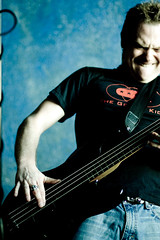
On the way home from that show, I ran into a friend of mine who's a great musician. Woode Wood is a fixture on the local running trail, playing his music and working on his videos. Things are picking up for him and he's putting a band together now. We hung out for a while and I was lucky enough to get my first guitar lesson from him. My fingertips are still sore. I was also able to arrange to license some of his music as the backing score for the slideshow - things are falling into place already! Check out his videos and vote for them on YouTube.

Friday, March 27, 2009

Pepper #30 (and what happened to the first 29?)

jackson pollock

One gallery that we visited in London was the Tate Modern, in the old power station on the South Bank. A huge space and a really dramatic old building set the stage for a varied and challenging art collection. The exhibits range from beautiful Cezzane portraits of his gardener, to small piles of firebricks and a sheet of cut out paper afixed to the wall. The more recent contributions to the collection seem to spend more time trying to challenge perceptions of art rather than really producing anything appealing or even displeasing to the eye, which seems to be a common condition of modern art. All form and idea, not much expertise or craft on display and not much consideration of the surface appearance.

In one room, a Mark Rothko colour painting of rectangular swatches hangs beside a massive Monet canvas of water lilies, facing a Jackson Pollock action painting. I sat there for a few minutes taking all three of them in and thinking about the crazy focus each of those three artists brought to such a narrow range of subject matters. The gallery had just recently finished a large exhibit of Rothko paintings, all very similar, different sizes, different colours, different arrangements but all his trademark swatches of rectangular regions of colour. I do wish I'd been there early enough in the year to take all of them in at one time, just to see them all in one space. Over the years I've seen many Monet paintings of waterlilies, huge panels, small paintings, different colour palettes awash with the same simple theme. Pollock's action canvases are similarly focused on the same techniques. Weston's photography of 30 peppers until he found the right one is a small example of a similar level of photographic commitment to a theme.

What drives someone to return to the same small set of subjects time and again? I've talked about creative constraints in the past but these three seem to take those ideas to further extremes. Maybe that is something that separates the great and good in the art world from the rest of us. This monotonic focus and manic ability to return to the same small set of constraints time and again to see what is there. Contrast that with the typical hobbyist photographer that always wants to argue for creative freedom of expression or never wanting to be boxed in by the same subject twice. I know repetition is a key to doing interesting things with a subject, returning time and again to find something new. I'm just not sure I could take it to the extremes I see in Rothko or Monet or Pollock.

Karen expresses concern that nobody would be interested in 35 images of clouds for a SoFoBoMo contribution, but I think if an image or theme is repeated often enough it can help the viewer start focusing on the differences between each instance of the subject. You start to really take the time to notice what is special about each individual composition, rather than just labeling and dismissing it as the general theme of all the images. The subtleties get a chance to come out.

Friday, March 13, 2009

mary ellen mark

Went to the ACP Mary Ellen Mark lecture last night. I was amazed by how many people showed up - they had to turn some people away at the door I think. A packed auditorium and an interesting array of images. One thing that stood out was she kept using the word 'relentless' to describe how to achieve the images she made. Going back, time and again, facing rejection and just turning up the next day to eventually get the acceptance and access she wanted to make the images. I'm already looking forward to the Alec Soth talk on the 4th of June. You can see more of Mary Ellen's pictures in the USA Character project. The rest of that body of work is also fantastic, with some great portraits by 11 photographers. Some really arresting images.

Thursday, February 12, 2009

eye in the sky

a cold day in London

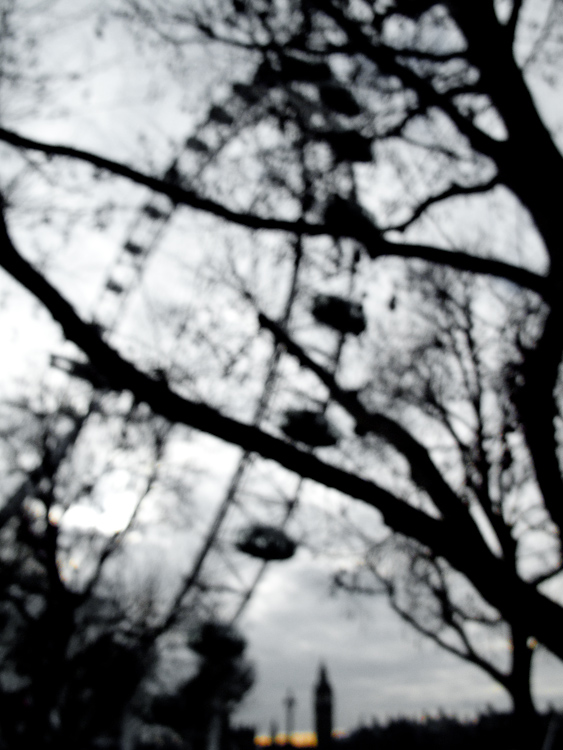
This shot continues a theme or merging of influences. I've found I really enjoy images shot totally out of focus. This is a technique that seems to sharply divide viewers. Some love it, some hate it, few are left ambivalent. There is a touch of impressionist painting in the back of my mind when I take these images, in fact trying to emulate that painting style is where I started shooting out of focus in the first place. Given Monet's many images of the houses of Parliament, this one seems particularly apt and was the reason I started shooting that way in London. This particular shot is also heavily influenced by a Keith Carter image, of the Eiffel Tower in Paris, shot through winter trees, with very selective focus. I've been down this path before, with the Zilker Christmas tree in Austin.

For a while I've been bothered about copying or appropriating ideas from other places, thinking I needed original ideas, or new and novel concepts of my own. Over time I've come to realise that borrowing or being influenced is the way the world works. I saw this earlier in the week, looking at a self-portrait of and by Rembrandt, in the National Portrait Gallery in London. Other paintings in the same room listed out wholesale lifting of compositions and poses from other older works. There is nothing new under the sun, after all. But if you take it and make it your own, you can't fail to find something new in the old ideas. Twyla Tharp talks about how any creative idea just needs two simpler ideas to be put together in an new way, to make a big idea. It doesn't have to be created out of thin air.

Thursday, January 08, 2009

building your own cameras

Got a link to these unusual cameras today. Seems he builds each camera with the express purpose of shooting a particular subject and ties the camera's construction to the subject matter. Not entirely sure what I think about that. Does the instrument really matter or change the images? It is more performance art at that point, or maybe look at me art? Certainly the end result strikes me as being more about the whole process, rather than just the resulting photographs. That strikes me as a common theme I've seen in various contemporary art galleries - the work is all about what the artist did to create it and the end results are of secondary, if any, importance.

Sunday, September 28, 2008

days with my father

Days with my father by Philip Toledano

Saturday, June 28, 2008

that was the sofobomo, that was

That's how the global blog traffic looked for this year's SoFoBoMo. A slow burn up to the start of the fuzzy month, then a crazy flurry of activity and now all but a receding memory. My book is finally put to bed and I still haven't really returned to using my camera. I'm in danger of becoming someone who used to be a photographer and who now owns cameras. I haven't been trying to force it though, focusing instead on other things to keep me busy.
I've wanted to review some of the SoFoBoMo books on the blog but haven't managed to find the time yet. In fact, I'd be happy if I just could look at all of the 59 finished projects. (Who would have thought way back at the start of that graph above that we'd see 59 finished books! - an awesome achievement all around). The simple whimsy of ndalum78's I can count charmed me the first time I saw it and still brings a smile to my face thinking back on it. Such a simple idea, very well executed. I think there's often a tendency to over think these sorts of projects, aiming for a complex message or set of ideas, when a really clear, simple concept can be beautiful if treated well.
Bernie Sumption's Eyes project is another that stands out in my mind from the early finishers. It was an example of great technique and a clever concept, handled in an interesting way, combining the head shots with the eye images to create a unique blended portrait of each subject. There are many more books that arrived later that I haven't yet seen. Maybe it'll rain some day in Texas and I'll have the time to investigate further! I am starting to feel the old familiar tugging to pick up the camera again. My 'other' book project, that SoFoBoMo was the pathfinder for, has started impinging into my consciousness again. I was lucky enough to get a MacBook Pro for work and have been exploring some of the writing tools available exclusively on that platform. I remember reading enviously about tools like Scrivener, when I was trying to outline the book. Now I have access to them and maybe that'll be enough of a jolt to move the project forward. New toys always help! I also think I'm going to be trying to resurrect the Everyday Ironman project in 2008/2009. It didn't happen this year for a variety of reasons, weather, injury and a whole host of other excuses. But the same team is putting together an even bigger contingent for the 2009 Ironman Coeur d'Alene and I'm going to attempt to document it this time around. The race is later in the year, so the weather should be better. Not so many workouts in the dark depths of winter and hopefully I should be a bit more mobile next year and able to keep up!

Thursday, June 26, 2008

shining eyes on one buttock

There's a lot of classical photography I don't get. Much of the sort of images that are hailed as old masters in the art leave me mostly cold. Largely, I think that's because I lack the historical context to realise how radically different they might have been at the time. Michael Johnston takes people to task in passing who say this about William Eggleston in this blog post. I feel that's a good example of what I mean. The context he describes suddenly makes it all make sense - I just didn't know enough beforehand to recognise why it might be interesting. Looking backwards, it looks just like everything else that went after. Another good example is the Steerage by Steiglitz. I've seen it several times before, but it wasn't until I got context for the image from one of Jeff Curto's great photographic history lectures that I could understand why that fairly pedestrian composition was so radical for its time. the context he provided made the image make sense.

In this great TED talk, Benjamin Zander provides context for classical music in a way that I haven't experienced before. There is maybe something to consider in there about looking at bodies of work of photography, rather than individual impulses or images as well. Even if you don't get any photographical inspiration I still think it is well worth the 20 minutes it'll take you to watch it. The parting thought is something to ponder for a while.

Tuesday, June 17, 2008

back to basics

I talked to a friend at the weekend who works with a lot of alternative photographic processes and equipment. He has an eclectic array of different film and digital cameras and makes some beautiful images. This time he walked in with a large box under his arm. Proudly he showed off the prints he'd been making with this several foot square cardboard pinhole camera that he'd made. It was fascinating. The negatives were about 2 foot by 3 foot, made directly on photographic paper, through a small brass pinhole on the side of the box. He used a magnetic shutter (well, a thin fridge magnet) to make the box work and sealed it up at home prior to going out and shooting his one, large frame. The camera is the big green box in the shot below. He estimated that the pinhole was probably about an f256 aperture and the image was sharp right across the plane. There was a concave film holder at the back of the box (a flexed piece of card). The simplicity and elegance of the entire camera fascinates me, compared to the technical and electronic marvels that many of us use. The shot at the top of this post is another of his images, this time taken with a pinhole camera made from a tin can. It isn't perfect, but there is a charm and character to the image that is absent from a lot of the technically perfect but less than exciting digital imagery that you can find around. More than that, there is a magic to it - a tin can and some light sensitive paper and a bit of chemistry and you end up with an image. It reminded me of the room-sized camera obscura that is shown in one of the genius of photography episodes. A team rent a hotel room in Rome, across from a famous church. They black out the windows, install a small aperture as the only place that light can enter the room, then watch and wait until their eyes adjust and a perfect, beautiful, inverted and reversed image of the church across the street appears on the opposite wall. Magical. I've enjoyed similar effects from small holes in the window blinds in my bedroom, watching the early morning sun dance small images of the trees in the garden across the wall. We also got to talking about various larger sized camera obscura and one image stood out as particularly whimsical. He mentioned someone who sensitises paper across the entire back side of a large pin-hole camera then is actually inside the box during the exposure, dodging and burning the image as it is formed, from inside the camera. Using their whole body to block and shape the light hitting the paper. It just seems such a wonderfully organic way to interact with the print that I'm fascinated. Perhaps even more so because I've never even experienced the basic process of printing a black and white image in a darkroom - something I want to try, before it all disappears.

Friday, April 04, 2008

what is art ?

Fantastic. I think that settles everything.

Sunday, March 30, 2008

the candid frame

dorian graydorian graydorian gray
Ibarionex Perello keeps plugging away with his excellent series of interviews over at The Candid Frame. He has been producing these interesting and in depth podcasts for almost two years now and is on the 49th episode. Well worth dipping into the archives if you haven't heard them before. He talks to a wide variety of photographers, working in different styles and with different goals. There is a lot of insight into the process and working life of these creative people that I've found inspirational and entertaining. He's had a few technical hitches in the last couple of months but things are back on track with a great interview with Erin Manning that delves into her approaches for working with people and interacting and getting the expressions and shots that she wants. Good stuff if you are interested in getting better at that aspect of photography. A great podcast and worth the download. I always look forward to the next interview. You can stream interviews from his blog, or subscribe to them via iTunes.

Thursday, March 20, 2008

sunspot

sunspot sunspot sunspot
One of the bands I enjoyed the most at my brief time at SxSW was Sunspot. From Madison, WI, they were obviously enjoying the warmer Texan weather this weekend. I listened to several of their songs at Agave and picked up a CD which has been playing for most of the week in my car. They are self-described as arena rock for geeks and their music reminds me a lot of They Might be Giants or Weezer. Catchy, funny lyrics and good tunes. You can listen to them at the link above. In particular the homage to Quantum leap, Scott Bakula, is a fine track, with the lyric 'Scott Bakula never smoked crackula, he played quarterbackula in 'Necessary Roughness'. Worth checking out.

Sunday, November 18, 2007

heading back E.A.S.T.

heading back E.A.S.T.

As I mentioned, on Saturday I went around a few studios in East Austin as part of the East Austin Studio Tour. I decided to take my camera along to do some portraiture. I've got an opportunity coming up to shoot some artists for a non-profit organization and wanted to explore doing environmental images, of artists with their work, but without the pressure of expectation on the results. I gave myself the assignment to shoot 5 portraits that I was happy with. I think I mostly got there!
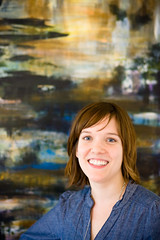
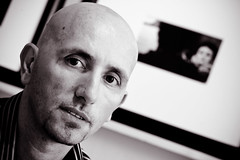
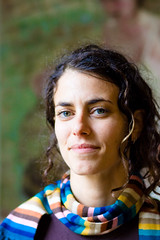
I really enjoyed seeing around the various studios that I went to and I got to meet and talk to some very generous and interesting artists. There was such an inspiring variety of great work on display, too. I deliberately didn't pay any attention to which studio I was going to next - just picked an area on the map, then walked around, following the numbers. This meant I had no idea what sort of work I was going to be seeing - I wasn't bringing any preconceived notions of what I liked or didn't like, didn't skip artists that did work I wasn't interested in. So I saw a lot of new ways of seeing and expressing. A great way to spend the day. From full frontal male nude photography, to Hispanic religiously-inspired art, I saw it all. Caroline Wright (left) paints gorgeous abstract images, capturing beautiful light and scenes that I could just get lost in for hours. Lovely use of colour and space. It was intriguing to hear how sound inspires some of her work and you could really see the dynamic tempo in those pieces. Ava Sharifian (above) paints what seem to be organically inspired, colourful canvases, full of movement and life. Her work was so dynamic and lively. Spirals of brush strokes blending in to planes of colour, huge canvases that seemed just perfect. I wouldn't know how to even start creating something like that - the huge empty canvas would haunt me. Perhaps I'd have even more trouble knowing when to stop. Piercarlo Abate's studio was the first place that I stopped on the tour - he also happened to be number one on the list. He really set the tone for the whole day - warm, friendly and inviting, with some great photography of Venice and also some lovely portraiture work. We talked for a while and he made me feel very welcome. He was also shooting a project, using the people visiting his studio as part of his art - seemed like a great idea! You can see a video of the project he shot last year as part of EAST, on his web site. Jennifer Balkan (below) had a wide variety of nude studies in her studio - but a piece that she had done of a rabbit, in a Alice in Wonderland theme, really caught my eye. Deep purple drapes set off an almost blue, white rabbit. I think it was the use of colour that really caught my eye about that piece. She also does a lot of work mixing in maps with figures, combining the sense of anatomy and networks of veins in a body with the similar feeling that can be found in a map - waterways, arterial roads and the like. Really interesting work and my friend Erin was really excited to see I'd taken her picture! The final portrait I took was the one I posted yesterday, of April Bederman, who makes dramatically colourful hats. She was showing in a part of a studio that was shared with Barry George who is a sculptor, working mostly in metals. April's hats were on display on some of that sculpture and the mix of hard iron and her bright, soft fabrics was quite unusual. I visited a few other studios and artists - but these were the people who I felt I managed to make some small connection with and were kind enough to work with me on a portrait. What they didn't know was that I printed out my favourite shot of each of them and then went back around this morning to give them a print. I got quite the range of reactions to that. Everyone was very kind and positive, but most of us have a hard time when faced with ourselves in a picture. I think that's why so many photographers create self-portraits that are so abstract or hide the face. We all have our issues to deal with. It was a lot of fun to be able to turn up unexpectedly and hand over the print. I spent quite a bit of time talking to April again today and she turned the tables on me and took my picture. I suppose that's fair game! EAST was a great experience - I'm really glad that I went. Also setting myself this small assignment meant that I made more of an effort to connect with these people and find out about their art and motivations. I got a lot out of that experience that I don't think would have happened if I just went in and looked quickly, then moved on.