Showing posts with label landscapes. Show all posts

Thursday, February 12, 2009

eye in the sky

a cold day in London

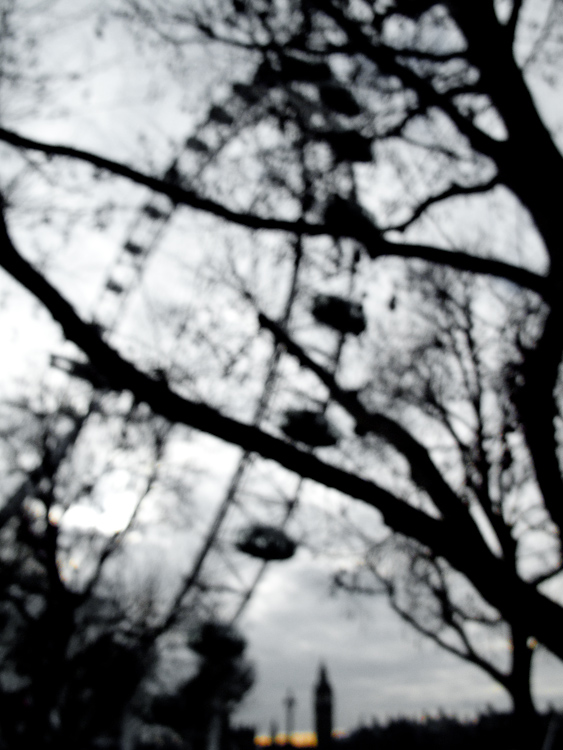
This shot continues a theme or merging of influences. I've found I really enjoy images shot totally out of focus. This is a technique that seems to sharply divide viewers. Some love it, some hate it, few are left ambivalent. There is a touch of impressionist painting in the back of my mind when I take these images, in fact trying to emulate that painting style is where I started shooting out of focus in the first place. Given Monet's many images of the houses of Parliament, this one seems particularly apt and was the reason I started shooting that way in London. This particular shot is also heavily influenced by a Keith Carter image, of the Eiffel Tower in Paris, shot through winter trees, with very selective focus. I've been down this path before, with the Zilker Christmas tree in Austin.

For a while I've been bothered about copying or appropriating ideas from other places, thinking I needed original ideas, or new and novel concepts of my own. Over time I've come to realise that borrowing or being influenced is the way the world works. I saw this earlier in the week, looking at a self-portrait of and by Rembrandt, in the National Portrait Gallery in London. Other paintings in the same room listed out wholesale lifting of compositions and poses from other older works. There is nothing new under the sun, after all. But if you take it and make it your own, you can't fail to find something new in the old ideas. Twyla Tharp talks about how any creative idea just needs two simpler ideas to be put together in an new way, to make a big idea. It doesn't have to be created out of thin air.

Monday, December 08, 2008

posts from around the intertubes

end of summer

Something of a hodgepodge of links to things I've found worth a read in the last couple of weeks.

First to New Zealand, and Tony Bridge has a great post about the use of rules in photography and camera club judging. I've suffered from this experience a couple of times in the past. The trick I think is to get a deeper level of understanding - go beyond the superficial 'tips and tricks' aspect of the various photographic rules and understand what they are really about. Then, you can use or ignore them with some understanding of what you are trying to achieve. Along those same lines, Merlin Mann is something of a reformed version of his former trickster self and is bemoaning the sea of tips and tricks out there. He's come to realise that getting to a level of deeper understanding actually requires work. For photography, you have to take and look at a lot of pictures, to get to grips with what composition is about, not just read some books. The focus of 43Folders has switched towards more of a creativity bent, so is getting more intriguing, as it moves away from the productivity porn.

Mark Hobson has been waxing on about the process of developing vision, and if that even means anything, on the Landscapist. I like that Mark typically goes deeper into these notions than the conventional wisdom. Another fine discussion on deeper ways at looking at photographs can be found in this Daily Critique from The Mindful Eye. Craig does a great job of breaking down the more interesting aspects of how rhythm and relationships can be used within a composition to make the parts relate to the whole.

Tuesday, September 23, 2008

5D MkII

sentinel
I try not to post a whole lot about the technical side of the camera world. I think there are plenty of sites that do it much better than I'm ever interested in doing and also there isn't enough out there about the less tangible aspects of this hobby/art/obsession.

Same goes for the photographic books out there, page upon page of technical information, very little on the thought processes and approaches being taken. Freeman Patterson is one of the best at talking about the 'inner game' of photography. Galen Rowell ventured into it on occasion too. It's a short list, compared to the technical authors, talking aperture, shutter, Photoshop buttons and widgets. John Paul Caponigro does well at breaking down the 'why' for editing, rather than the 'how' but again, most of the other authors focus on how to do things, not when or why you should or should not.

I think the main reason is it is easy to talk about the technical aspects. There are hard and fast answers to what an aperture is and how to open and close it. Doesn't require a lot of introspection to explain how to use the clone tool.

That said, I'm really excited about the Canon 5D mkII from what I've seen. I want to get a full frame camera. My 1dII is a 1.3x crop and I feel constrained on the wide end when shooting landscapes with a 17-40 F4L. When I first got this wide-angle lens, I was really frustrated with it. Even on a Canon D60 (a 1.6x crop sensor) I could never use all that visual space. I had a hard time composing anything that would be compelling. I loved using a 70-200 telephoto and a 100mm macro at the time, could crop and compose tightly and create interesting images. But the wide-angle end of the range really frustrated me. Everything would be too small, too disconnected.

That was, until I did a workshop with Craig Tanner, who taught me about his rhythm method of landscape composition. I learned to realise that I wouldn't just stumble upon a good wide angle composition - mainly because your eye just doesn't see that way. You can see telephoto compositions more readily, because you are just cropping out parts of what you can actually see, but not so with wide angle. You have to look through the lens to see what you'll see then. I learned the idea of constructing a scene, finding some key element in the landscape for the composition, then finding other parts to rhyme with it and build the composition, piece by piece. It might be the shape of a cloud and some bush, a crack in mud and the slope of a mountain, anything that can tie pieces of the scene subtly together, making your eye move around the composition. You can do this with a wide angle lens much more readily, because small changes for the camera cause dramatic shifts in the scene. Elements can be quite easily shifted in and out and across the frame, particularly in the foreground.

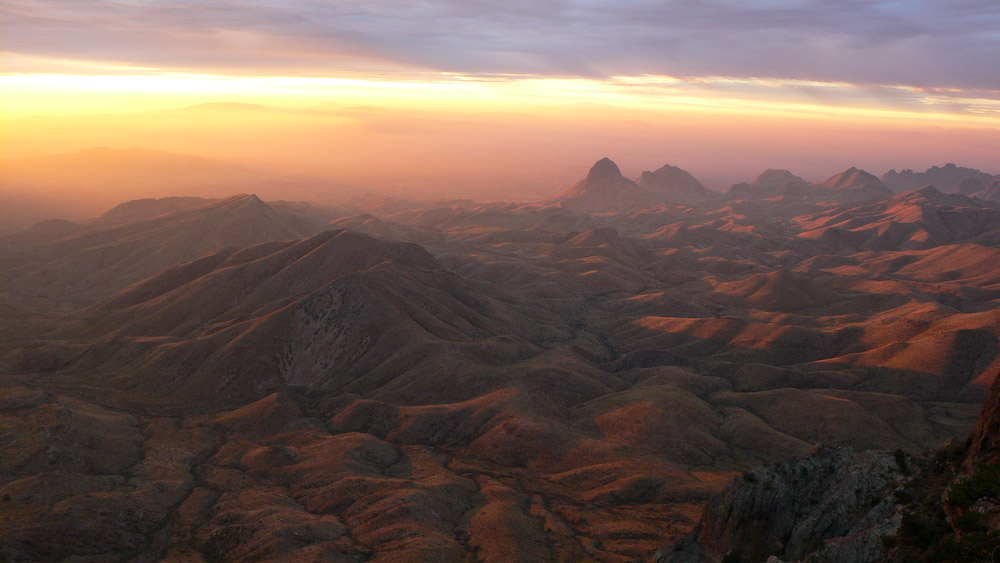
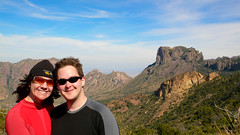
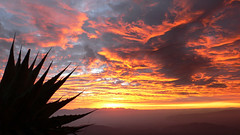
After a few days of practice, this approach started making my wide angle shots work. I began to find myself frustrated that I couldn't go wider, rather than struggling to make an effective 27mm frame cohesive. The 1.3x crop Canon 1D MkII helped a bit, but still I want more. 22mm is getting there but I want full frame. The other aspect I've found using a 1DII for landscapes is that it is a heavy, solid camera. The new 5DII is about a pound lighter so I'm hoping it'll be better for hiking. There have been trips I decided to forego the 1DII in favour of a small point and shoot, just to keep down the weight. A two day hike up to the rim in the Chisos mountains in Big Bend is one opportunity that stands out in my mind. We had to carry all our water up the mountain side and I didn't feel up to lugging a 1-series body and lens with me. On the rim we were treated to some of the most spectacular sunrises and sunsets I've ever seen. Maybe next time I'll have a more portable camera!

Also in the last couple of years I've moved more towards portrait photography and I think the 5DII is going to be fantastic for that. The frame rate is good enough but in particular the higher ISO modes are exciting, particularly for low light street portraiture. I've had a lot of fun shooting portraits at night in Austin, with a fast lens. I can get away with ISO 1600 on the 1DII for grainy black and whites and from the samples I've seen the 5DII looks to have great low light, with a usable ISO6400 and the option of heading to ISO256000 which is ridiculous. The smaller camera might be less intimidating to strangers when I approach too - not sure if that'll be good or bad.

Full frame, lower weight, great low light and a much bigger sensor than my current 1 series body. Almost everything I could want. I'm going to keep the big tank for sports shooting, 8.5fps is quite addictive after a while - I've even occasionally shot movies with that, in a jerky flick book way.

The final feature of the 5DII is the movie mode. 1080p resolution video up to 12 minutes long. I've dabbled with creating the semblance of movies with my cameras, trying to mix in audio, stills and video. So I'm excited to get to try this feature out. There is an amazing video shot with the 5DII on Canon's site, showing off some of the features of the camera. Mostly amazing because it was put together in a 3 days. The story maybe could with work but it looks lovely.

Monday, July 14, 2008

the natural world

tumble weed

I find that in contemplating the natural world my pleasure is greater if there are not too many others contemplating it with me, at the same time.

Edward Abbey, Desert Solitaire

Friday, April 18, 2008

sofobomo way

sofobomo way

The editing continues. When I started this project, my biggest concern was getting enough pages. Finding enough people to even meet the basic requirements and having the 35 images. So I shot a lot and shot quickly. Now I have the reverse problem. Too many pages and certainly too many portraits. More than enough. So I have to start cutting back and editing the book down to the best images. I'm left with the small dilemma of cutting images of friends. Sorry you didn't make the cut I'm sure is going to get taken the wrong way by some. When I say the pictures aren't interesting enough, someone will hear I think you aren't good looking enough or various other misinterpretations. If the pictures aren't in the book, it will be because I didn't make an interesting enough picture. Honest! Some of the sessions went better than others. Some of the locations I picked were better than others, for lighting, for background. Other shoots I just plain screwed up because I was working quickly or just nervous about the whole thing. Most of the time I spent no more than a few minutes with each subject. I'm used to getting maybe one usable image out of that sort of session and not trying to extract half a dozen or more. I am taking on board Julia's comment about too many pictures distracting from each individual image and for some pages, keeping things very simple. For others, all of the shots will be on display - again, trying to mix it up and keep it interesting. Still showing different expressions for each subject, even if the number of shots varies dramatically. That's the beauty of shooting landscapes or macros, they don't get offended so easily.

Wednesday, April 09, 2008

cow creek

cow creek

A break from the constant barrage of SoFoBoMo posts. I spent a bit of time this evening looking through the final day of shooting that I did in Death Valley. I'd woken up early that morning, with a vague plan to go back to the sand dunes near Stove Pipe Wells for a final sand shoot. I'd met a few people that I was going to shoot with and we all got together at 4:30am. The wind was howling. But they were all feeling hardy and still wanted to head to the dunes. So I wished them luck!
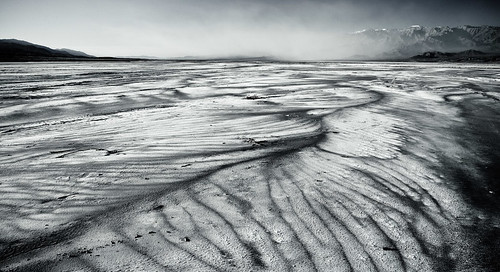
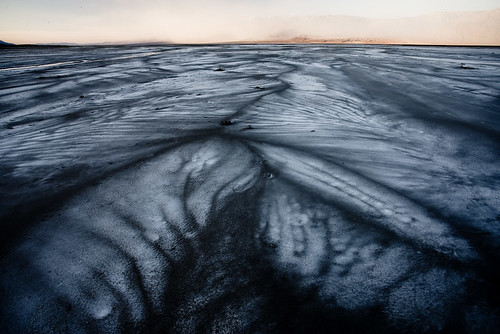
Instead I went with another group down towards the salt flats near Cow creek. I'd scouted that area on the Saturday when I'd arrived and found some really beautiful fan shapes in the salt. I'd walked out without my camera, towards the center of the valley on that first day, just to get away from everything and listen to the wind. The water and wind had blown rivulets into the salt pan and the shapes were achingly delicate. I'd hoped to come back when the light was good and marked some GPS co-ordinates so I could find it easily.
So on the last morning, I got my chance to go back and it was breathtaking all over again. Such graceful sweeping patterns leading off to the far mountains. The sand from the Stove Pipe Wells dune fields was filling the air in the distance, blowing down the valley and obscuring the hills but maybe adding some interesting mystery to the scene, too. The wind was whipping around my ears and it was a joy just to be up and out there to experience it.

Tuesday, April 01, 2008

small world

telescope peak and me
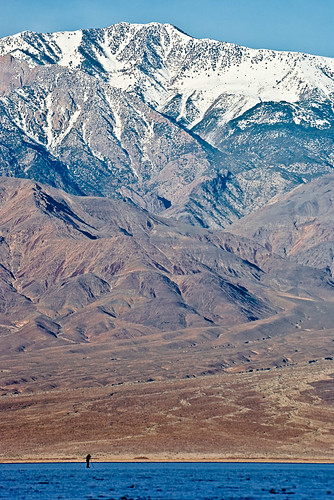
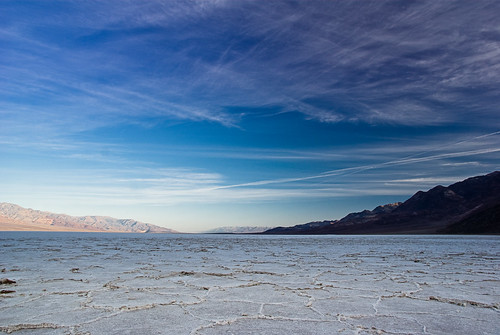
Terry Lawhon got in touch with me after seeing one of the shots I took at Badwater, on my birthday. He thought he recognised the cloud shapes from one of his shots! Turns out he was also out there that morning and took a shot of a photographer that was far off in the distance out on the Badwater salt flats. So that's me, above, in Terry's shot, shooting on my birthday and taking this picture, which has the same cloud form in it that Terry was also shooting.
badwater
badwater
I've never met Terry, we only found out about this conflux of location when he read my blog. Also Terry mentioned it was his birthday a few days earlier. Thanks to Terry for sending me the shot and also letting me share it here. You can see more of Terry's images from Death Valley at his website in the portfolio section. Small world.

Wednesday, March 26, 2008

high dynamic range - it's not just for Saturday mornings

3 image hdr
I've never really gotten the taste for the typical High Dynamic Range images. Trey does a great job in that style, but it just doesn't connect with me. So I've tended to avoid HDR tools. Occasionally, however, I get presented with a scene which is beyond the dynamic range my camera can handle. Usually I'll bracket the exposure then mix the images later with masks. Recently I signed up for a beta program of a new HDR tool. Most of the default results from the tool have the typical extremely high local contrast look that seems so popular to add in the tone mapping stages. But it can be dialed back and controlled to give a less obvious effect. I found I was able to blend several exposures without too much trouble, to get something much closer to what my eye could see, but without the overloaded local contrast in the image.
2 image hdr
I'm no expert at HDR (I think I've been happy with three final images in total) but it can be a useful tool to have in the back pocket, particularly when it can be used without being such an obvious part of the final result.

Sunday, March 23, 2008

birthday in the valley

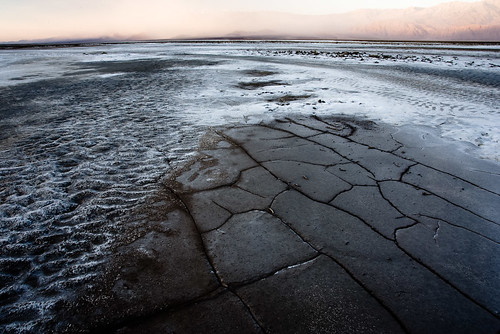
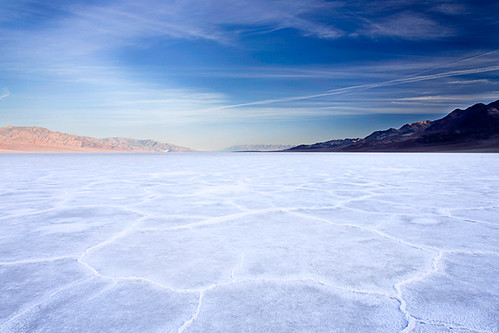
One of the reasons I went to Death Valley at the beginning of the month was to spend my birthday out there. Amanda was away for work and I wanted do something, rather than sitting around the house! I spent the first few days doing a bit of short hiking and taking a lot of pictures. I wanted to try something a bit more adventurous on my actual birthday. I got up bright and early on the 4th, at 4:30am and headed out to the Badwater salt flats to shoot the pre-dawn and sunrise. A quiet, soft start to the day and almost nobody out there. I walked out further than I've been before, about a mile and a half, to where the salt really gets flat and white. Peaceful, beautiful and not a sound. Amanda recorded herself singing 'Happy Birthday' on my birthday present, a digital audio recorder, so I listened to that a few times out there!

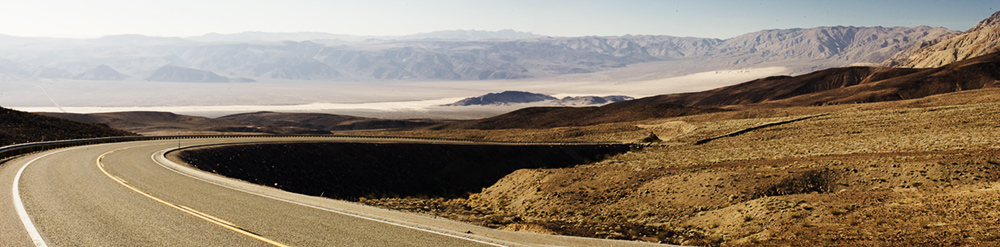
After breakfast and a bit of packing, I drove over to the Panamint Valley. Both times I'd been to the park before I'd looked longingly at the Panamint dunes. They are a bit tough to get to - about 6 miles of dirt roads then another 5 mile cross country hike, over a rocky alluvial fan then up through sand dunes. You can see the road in the distance on the far left of this shot and then the dunes on the hillside to the far right. This time I was going to get there.
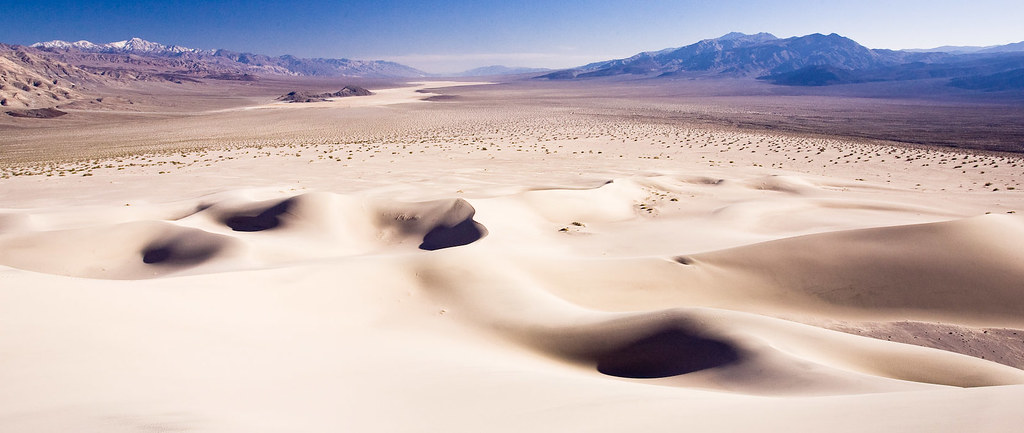
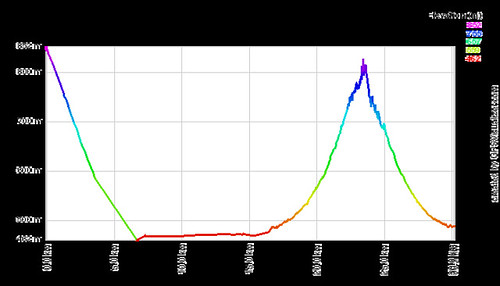
The hike was great - I took about a gallon and a half of water, my camera and some food and set off up to the dunes. It was a warm 85F and sunny at the start and got pretty hot as the afternoon wore on. Click here for a flickr slideshow of the hike. The soft dirt and sand made for quite tough going and I averaged a slow 2.5 mph on the way up. Just before the dunes, I found a big creosote bush and slept under it for an hour while the shadows lengthened and the light got better for photos. My Tilley hat made for a great shade, hung up in the branches of the bush. That was the first respite from the sun I'd found all afternoon and it was really welcome. So much cooler out there out of the sun with the really low humidity. Lovely. About 3 pm I left the pack behind and walked up into the dunes with my camera. It was a beautiful experience to have that whole expanse of dunes to myself, no foot prints, no people, no noise. Nobody for miles around. The dunes there are steeper than those near Stove Pipe Wells, the hillside and wind have combined to really pile them high and sharp. A couple of times I wasn't sure I'd be able to make it to the top of the highest dune, I almost rolled off down one slope. Eventually though I clambered to the top - the view was stunning - all the valley opened out below me. The narrow peak of the dune actually split into the 3 spines - a star shaped dune! Shooting right at the top was a bit disorientating, looking through the camera and trying not to step off into space. I sat for a while and drank it all in.
Heading back down was a whole lot easier, once I found my pack. Creosote bushes all look the same from a distance! A GPS waypoint made life easier, though I did worry about my batteries dying. It was all downhill to the car and not so much weight to carry either. I think I need to find some hikes where I start off at the top, hike down drinking the water then have a lighter load to carry up the hill! I got back to the car just as the sun dipped behind the mountains. All in all, a great way to spend my birthday. A really beautiful desert hike.
Lots more pictures in the map below - click on the labels on the right or zoom in and pan around.
I've been trying out various GPS tools and GPS Visualizer has been really useful. Massaging the data into a form to create the map above took a bit of work, some use of GPSBabel and a few custom python scripts that I wrote to convert co-ordinates into the right forms. The profile came straight from the GPS track log.

Saturday, March 22, 2008

australia

badwater

badwater basin before dawn.

Friday, March 21, 2008

dune dawn

dawn

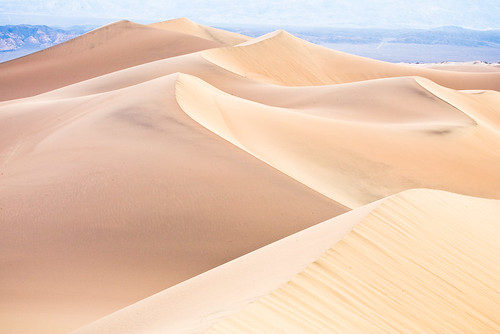
Early morning light, at Stove Pipe Wells dunes, Death Valley national park. Dawn is special to me - most people are sensibly tucked up in bed, asleep. The light is softer, creeping across the land. Sunsets are easy. Everyone is up and about for them, everyone shares in them. But dawn is special, solitary, beautiful. My favourite time of day - when I can get out of bed.

Friday, February 29, 2008

Death Valley, after the storm

Death Valley, after the storm

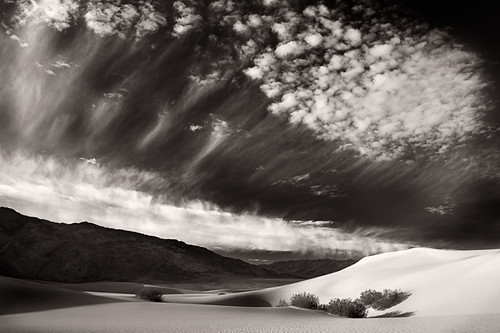
I'm heading off for a few days to Death Valley National Park. It's my birthday and I'm taking a few days to do some shooting and maybe try to write a bit more. This shot here is one of my favourites from the first time I went to the park. I'd been shooting all week and this was the final day. We were stretched thin by lack of sleep and there had been a blowing sandstorm a few hours before. I'd hiked out with the group through the sand and got some beautiful shots of the sunrise. I was tired and finished. Walking back to the car with the instructor, Craig Tanner, we were just chatting about things, then suddenly we noticed this scene unfolding in front of us. I was tired, ready for breakfast and almost didn't bother taking a picture. The sun was up. The shadows were getting pretty harsh, it just didn't look like a good photo to me, but Craig was excited. So I took a couple of frames. For me, this was probably the biggest lesson of the trip. I still haven't quite worked out what that lesson was, though, three years later. So I'm going back for another crack at it. See what I can learn on my own this time, listening to my own thoughts. I think since then, I've come to learn what a huge part clouds play in Craig's process - so maybe that was part of his excitement. I was on my first ever landscape workshop and hadn't really taken that concept in, until I got home and looked at the images I shot this particular morning. I was also still pretty green at making black and white images - still am really. This shot took a bit of coaxing to really appear from the original. Mostly though, this shot takes me back to the conversations I had that morning and the feelings I had enjoyed surviving the blowing sand and making great pictures. Nobody else gets to feel about this shot, the way that I do and that's okay. Maybe that's the lesson - the images have to stand on their own, as they don't tell others how you felt when you took it. Unless you really manage to put your heart and soul into them.

Thursday, November 29, 2007

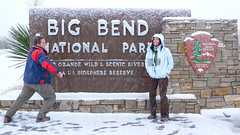
big bend

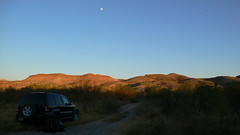
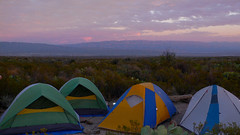
I love Big Bend - such a beautiful, harsh place. So many extremes and different landscapes in one location. Thanksgiving is the busiest time of year, so we tried to get in early. Left from Austin at 5am on the Wednesday and arrived at the ranger station around 1pm to find that almost all the campsites were already reserved. Luckily enough, we'd rented a 4 wheel drive Jeep so could access some of the more out of the way back country sites. We picked Gravel Pit 4, on the West end of the River Road. Not that inspiring of a name but we were told this was one of the better sites. It was down a long, rutted, gravelly and sandy road in a small copse of trees. The roads are fun in the right equipment but I wouldn't like to take a 2 wheel drive car down there - though some manage. On the first day it was over 80F. Hot. Dry. We set up our tents and went for a wander around. We were about 50 yards from the Mexican border - the Rio Grande river was just down a path from our camp site. The sun was setting as we started to make dinner, a clear blue sky overhead with the moon rising, close to full. Lovely.
That first night was windy, with gusts up to 41MPH and about a pound of dust dumped in each tent. I didn't get a lot of sleep as the tent was flapping around so much in the wind. Woke up with a light layer of the desert on top of us all. The temperature had really dropped over night but at least the wind died down. Another beautiful sunrise over the desert.
in big bend
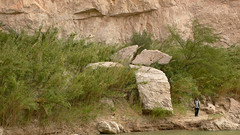
We had breakfast, broke camp and moved on. That morning we hiked in to Boquillas canyon and listened to Victor, the singing Mexican, serenading us from just over the border on the other side of the Rio Grande river. His tip jar is in the US and he sings from Mexico, sneaking across every now and then to pick up what might have been left for him.
singing across the border
After that we drove the fun and rutted Old Ore road to Ernst Tinaja. This is one of my favourite parts of the park - a narrow canyon with beautiful light and some really tortured rock formations. Saw a couple of rather furry tarantula spiders on the way into the canyon. We had lunch in there then moved on to the hot springs. Along the way, I talked to the guy behind the counter at the Rio Grande campsite store and found out that many tents had broken in the wind, the previous night. Somehow we all got lucky - though four of our group decided enough was enough and headed back home.
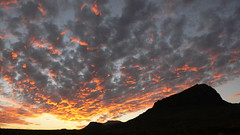
That night we camped beneath Nugent Mountain (site NM1)- beautiful sunset, amazing clouds, freezing winds and temps in the 20F range. Did I mention it was 80F the day before ?! Nugent mountain is a really interesting photo op - a dramatic silhouette. It was frigid the next morning. Cups of tea and coffee helped but eventually the sun rose over the Sierra del Carmen range and warmed us up.
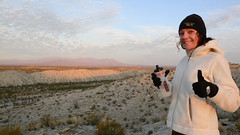
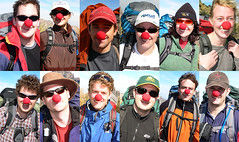
We broke camp and drove into the Chisos mountains basin for the big hike of the trip. We'd packed as lightly as possible for an overnight hike. We climbed up the Laguna Meadows trail from the basin ranger station, up onto the south rim of the Chisos range (at around 7,500 feet). Carrying about 2 gallons (16 pounds) of water each on our backs, along with food, tents and lots of warm clothes. We had ended up in the furthest backcountry camp site (NE4) from the starting point and there had been a mountain lion sighting at the camp site just the day before (the ranger was really excited for us all!) The hike out up Laguna Meadows is beautiful - not too step and some great views. Once we were at the top, about 3 miles in, we stopped for a break and took in the view. I produced a red nose and used it to get a set of pictures of all the hardy souls we were hiking with that day.

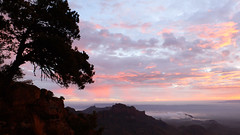
Up on the rim, the hiking got a lot easier - a 4 mile stroll around the edge to the camp site. The views are breathtaking, over the edge to Mexico and the desert far, far below. We set up camp and were confused by a warm inversion that meant it was about 40F and calm/ comfortable up there at 7000+ feet. Spent probably the most comfortable night of the trip up there, watched an amazing sunset and woke up for an even more breathtaking sunrise. The site is a bit back from the edge and quite sheltered from the wind, but stunning vistas are only a few steps away. Happy and relaxed we broke camp and started our hike down.
Our group split at Emery point - about half of them went for the 2 mile round trip to the summit, while the rest of us headed down. My ankle is still bothering me a bit so I decided to go for the easier option. Sam and I talked about cameras and photography most of the way down - he'd been more crazy and brought a Canon 10D with him so I'd used it a bit through the day. My Panosonic DMC-LX1 proved a much lighter option and did quite well for a point and shoot camera (all the pictures in this post were taken with it). I do like the widescreen aspect ratio that it defaults to. Always wanted a digital panoramic camera and this the closest I can get to an X-pan. On the way down the Pinnacles Trail, about 500 feet from the basin and car park, we entered a cloud bank - a short while later it started raining. Half an hour earlier we were toasting in warm sunlight - not a cloud in the sky. We had watched the cloud pour in to the basin through the Window. Just as we reached the basin valley trail, the rain turned to freezing rain and the temperatures plummeted. About 10 minutes later I had a hard time opening my car door because it was frozen shut. Jumped in the car, turned the heating on and waited for everyone else to get down off the mountain - luckily enough we all eventually did!
Everyone got down from the hillside before it got too serious - we also made it out of the basin, down into the desert, before the road down was closed (I heard later that it was shut for over a day - so we were quite fortunate to get out). After that fun, we decided to head on home. Nobody felt like pitching a tent in the snow for the night! We drove along the road to Marathon in an increasingly fun blizzard, slipping and sliding around on the road. We managed to struggle in to Marathon and snagged the last two hotel rooms in the place. Settled down for the night in front of a roaring fire at the Gage hotel (well worth a visit if you can) and had some great steaks for dinner. Woke up the next morning and the sun was splitting the pavement - warm, beautiful clear skies, no wind. A perfect day in the desert, yet with everything covered in snow!
More snow was forecast but we high-tailed it out on the 'low road' back to Austin. Highway 90 follows the border to Del Rio then cuts back up to San Antonio and the snow disappeared really quickly on that route. Tim was thrilled to get to take us all through the border check-point and thankfully didn't say anything to get us deported. We made good time and got back to Austin in the early evening - exhausted from our crazy trip. I can't wait to go back the next time. Big Bend is a place of such dramatic contrasts. Each of the three times I've been has been really special yet wildly different. Get there if you can.

Wednesday, October 24, 2007

the amanda project

the amanda project

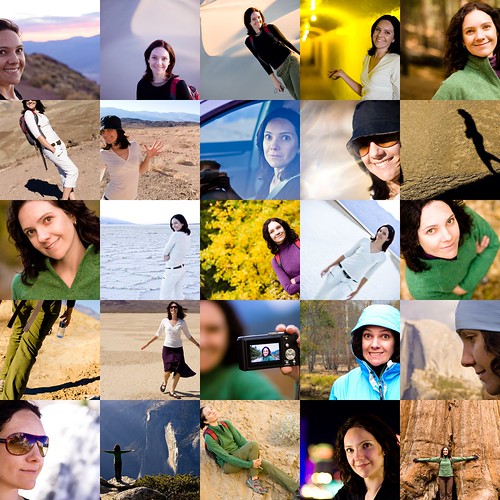
I've been talking a lot over the last year about the value of projects. A recent vacation to a few national parks seemed like the perfect opportunity to work on something with a consistent theme. For this trip, I picked my wife, Amanda, as the subject. The goal was to take a set of good pictures (around 20) of her that we were both happy with, in the various locations we found ourselves.
I decided to limit it technically too - I just took two lenses with me. I had a 50mm prime and an 85mm prime. The 50mm is one I haven't used much at all and the 85mm has been my go-to portrait lens for the last year. In fact, it's been my go-to lens for almost everything for the last year. I wanted to use the 50mm but put the 85mm in the bag as a fall back position. I tried to shake things up a bit by shooting almost everything with the 50mm. It turns out that about 90% of the shots I took were with the 50mm. Quite a turn around for me.
Now a 50mm and 85mm lens aren't exactly classic lens choices for a trip around national parks like Death Valley and Yosemite. Typically, you'd be thinking about some super wide lenses in the teens range and also a longer telephoto to abstract elements of the landscape. I decided to totally skip those options. I've been to Death Valley before and shot a lot of very wide scenics. I've never been to Yosemite but I've certainly seen a lot of classic landscapes from there. I wasn't going to compete with those images. I didn't even want to bother recreating various Ansel Adams views of the park, in worse light, or David Muench cloned images. Maybe I've finally gotten to the point where I have the courage to look for my own vision rather than copying others. Or I've switched to copying portrait photographers - I guess I'll find out over time. A few people suggested I was mad in taking this approach. That I'd spend the entire week regretting the decision or kicking myself, missing shots of a lifetime with the wrong lenses in my hand. Instead I took shots of my life and my times - I shot what matters to me. More valuable to me than pretty scenics of well-worn subjects. There's a joke that says half dome requires an extra stop of exposure now, than it did when Ansel Adams first took his shots of it, because so many photographers have sucked the light out of it. I contributed a bit, but with a slightly different motivation.
So the Amanda project was born, from an idea from Steve Barth with his excellent series featuring his wife. One week, 800 shots, lots of locations, dramatic changes in lighting, collaborations on clothing choices, hair. Hiking for miles, 4am starts, rain, bear sightings, climbing, driving : all in all a great time for both of us and I think a pretty good collection of images with a consistent theme.
I did cheat a touch on the only 50mm/85mm lens selection aspect - I took along a small, wide-angle, panoramic format point and shoot that I used a couple of times in this collection - but other than that, nearly all 50mm. I think there is one 85mm shot and that's the night image from Las Vegas. By the end of the week I was trying to find fresh ideas, use lighting, new focal lengths. I never actually felt I was missing out on shooting the grand landscapes by not having a wide angle lens. Yosemite is beautiful. Death Valley is amazing. We drank it all up, together, looked at the views, enjoyed the sunrises, sunsets and times in between. I did take a few landscapes and I'll start posting them up later, but I had a much more interesting project to work on, than scenery.
The project focus also pushed me beyond some of the standard portrait shots I'd have taken. I started looking for new angles, compared to how I've been shooting with the 85mm. Normally all I do is fairly tight head/shoulders portraits. The 50mm forced me to step back a bit. Shooting the same subject for an extended period forced me to look for new angles, new body positions, new ways to move. It got me thinking about posing a full person, even when they aren't posing as such, rather than just eliciting an expression. So again I found that pushing a subject area via an assigned project has helped me break new ground. I also pushed my lighting skills a bit, using room lights, rearranging furniture, etc. to light the night time Las Vegas shot. Something I probably wouldn't have done without this assignment in the back of my mind.
Hope you enjoy the results. We had a great time shooting them all. Click on the collage above to go to the set of images. Comments are very welcome.
In the comments, Kate asked: Of the shots in the project montage, were most with the 50mm? Of the 25 shown, 18 were taken with the 50mm lens. 2 were taken with the point and shoot DMC-LX1 and five were shot with the 85mm lens (old habits I guess).

Tuesday, July 31, 2007

Enchanted pool

enchanted rock

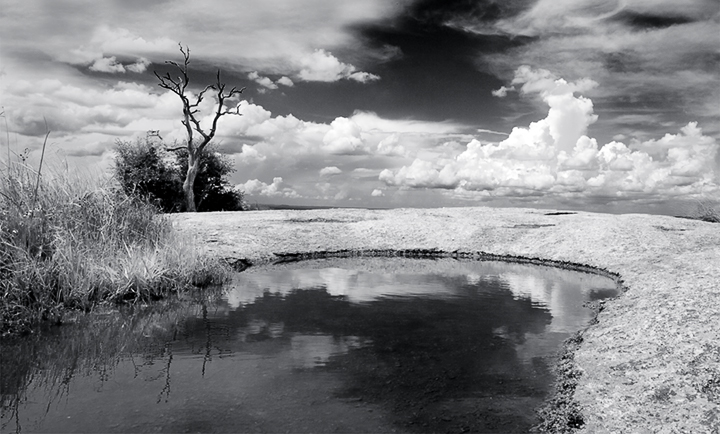
Took this shot on the top of Enchanted Rock. We've had a lot of rain in Texas for Summer. I read that it is 20 inches more rainfall than usual, so far for the year. Amanda & I took advantage of the gap in the rain to scramble up the pink granite to the top. I'd seen photos of the twisted tree at the top of the rock before but hadn't see much water there. This is actually a pretty small pool but I'm lying down quite close to the edge so the forced perspective makes it look quite a bit larger. I was trying to play with the reflections in the water and also balance the tree with the sort of similarly shaped cloud on the right hand side for contrast with the similar shape to the tree/ bush but inverted tonality. I'm not entirely happy with the sharpness in this shot, but that's what I get for not taking a tripod with me I suppose. Converted to black and white using the channel mixer, along with a selective colour layer to allow manipulation of individual colours. Mainly that was used to pull the somewhat mildly cyan sky towards a much darker blue that could then be converted to the dark black you can see here, to give contrasting clouds. The original was shot with a polariser but as I was trying to keep the water reflections, the effect ended up quite mild. Canon 1DII, 17-40 F4L