Monday, October 13, 2008

through their eyes

badwater

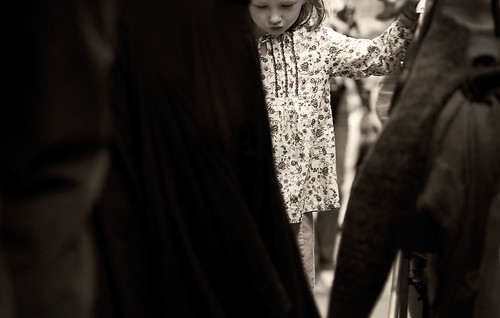
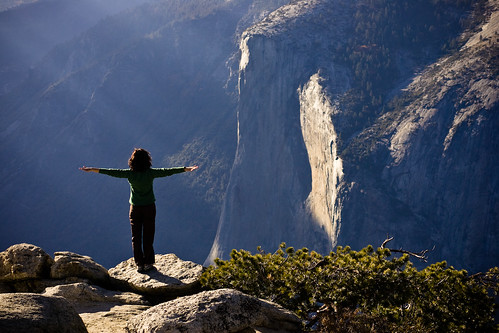
Paul's post reminded me of one of the things I've really enjoyed on the few workshops I've been on. You go out with a group of variously talented photographers and set up in typically beautiful locations. The place is pregnant with great photographic opportunities and everyone shoots their heart out. Later that week, everyone shares their best images or favourite images, or favourite, best images. Typically there are a few that make you think 'where were they?' How could those images have been made in the place that I was, with those other people.

It always inspires me, seeing how others see locations that I've been in, particularly at the same time. There's always more pictures to be made in any given place than you could ever hope to take. Seeing through someone else's eyes is a great way to find out what you might be missing. I'm thinking of getting a group of people together to try to explore this - explicitly no copying, just seeing what we can find.

Monday, October 06, 2008

xdrtb

http://xdrtb.org Harrowing images by James Nachtwey. Worth taking the time to look at the images and consider.

Sunday, October 05, 2008

suggest a workshop for 2009

tuscany

I've been on a few different photographic workshops over the last eight years. A few RMSP landscape workshops. The great Next Step workshop from Radiant Vista, local classes, trips to Tuscany. I get a lot out of spending a focused week just shooting and talking with other photographers. It's usually a great time too. I'm thinking about doing something in 2009 - anyone got suggestions or recommendations? Anything out there that's caught your eye or something that you've already done that you'd recommend? Comments welcome, even along the lines of don't be silly, don't waste your money, go do this instead...'

a mixed bag of lighting

amanda kevin

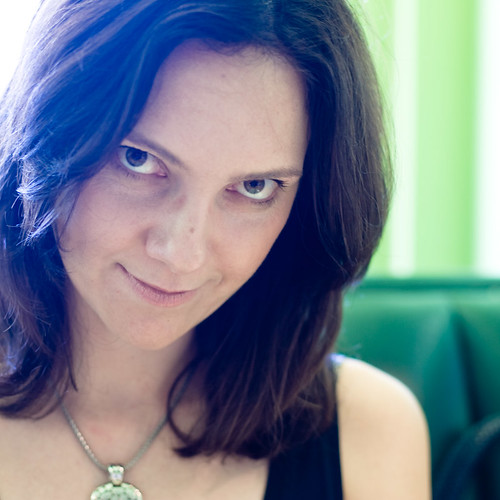
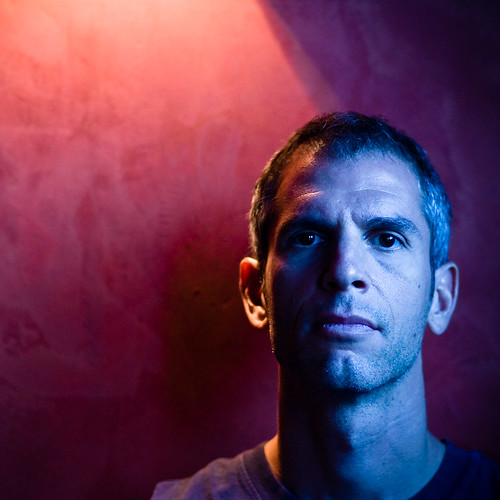
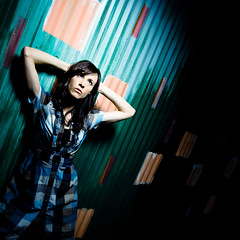
A couple of common themes for portraits in the last week. I did a lighting class last weekend and found while doing the more controlled, constructed lighting was interesting, I was still spending more time playing around with the ambient and trying to accentuate the lighting in the location. I'm not sure if I just don't really have the imagination to see completely contrived lighting, or I think really, I'm just not motivated enough to want to create it all from scratch. I do like finding the interesting light already available, then trying to build on that. I did some shots using strobes and adding in lighting, but I was still mostly working with the light I could find. One that I like was where I replaced the existing light with a strobe to essentially mimic what was there already - but being able to shoot at a much lower ISO and smaller aperture. It was in a hallway with a bare bulb hanging in the ceiling (below right) and I liked the light quality. With some help I put a strobe and a small softbox up in the same place, getting very similar light but slightly less harsh. A grid over the softbox helped control the fall off and edges, to shape it a bit more. I'd picked this hallway for the blocky green and orange wall paintings and thought it'd play well with the checked dress the model was wearing. All that I think works well, along with the lighting - but I struggle with posing a full body. That's why so much of my photography is tighter head and shoulders shots - fewer limbs to position and deal with.

kevin samantha

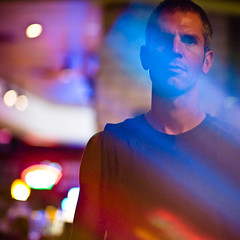
Another theme has been shooting using windows and mixing in the daylight with the available indoor light, playing with the mixed colour temperatures that you find around those edges. Eric Ogden has many portraits shot with the window actually in the frame, blowing out behind the subject and I tried a bit of that with the portrait of Amanda above. Just put the meter on center spot to ignore the background and shoot for these - nothing too clever going on. I like how the outdoor light turns slightly blue when her skin is balanced for the indoor light - made a bit stranger by the fact we were in a predominantly green-walled restaurant which added some unique colour casts to the shot. I also used an old idea of shooting through glass, for the second shot of Kevin, above, using the neon lights in the bar we were in, along with an empty, slightly dirty pint glass in front of the lens to create the coloured flare.

I've also been thinking about and cropping nearly all the shots over the last week to a square format. I've been shooting with that crop in mind and just seeing how it works for me. I doubt there will be a Hasselblad anywhere in my near future but that different crop has been interesting to work with. I'm blaming looking at Mark Tucker's portraits for that particular influence. I don't think it is something I'm going to keep doing much longer but it was interesting to try adding another arbitrary constraint into how I was shooting for a short time. It certainly changes how you arrange things in a frame.

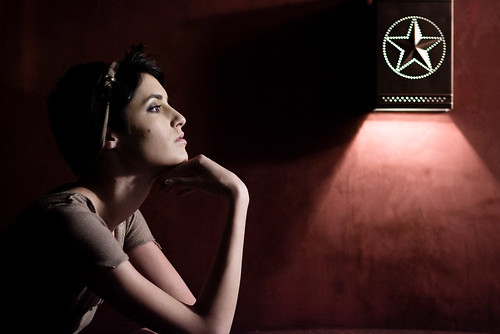
Another shot, (below) was lit using the available light and the modeling lights of the alien bee strobes that we were using. I'm not sure that that really counts as using the strobes properly, but any light that's available counts. the modeling light is low to the camera right, balancing with the wall light fixture. This could be another example of me only being able to see what the continuous sources give well and not having enough experience to predict how the brief strobe will act, but I much prefer working with the continuous light sources - it seems to suit my biases and process. Maybe I should be thinking about video more!

lauren

Monday, September 29, 2008

wait a moment

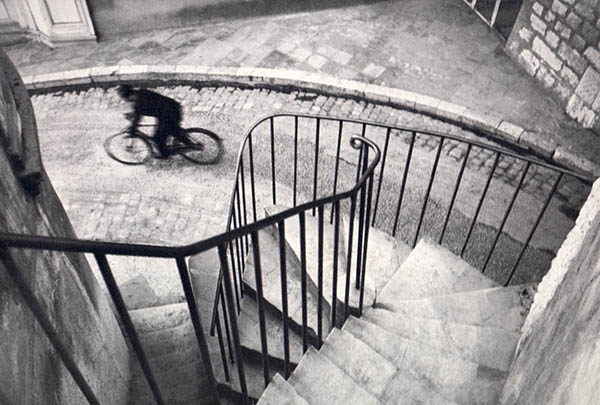
The little weekly group of photographers I shoot with decided to try to explore the 'decisive moment' over the weekend. The aim was to try to emulate the style of Henri Cartier-Bresson. One image that was discussed was Heyres. That's the town the picture of the cyclist, above, was taken. I looked at this and pondered if Bresson found this location then waited for a while to see what might come by. Was this purely a reaction shot to the cyclist, or had he considered the great framing opportunities of the staircase and road, then waited for the right moment for that scene? I'm sure talent and luck play a large part, but as ever I think that luck favours the prepared.

I did a bit of searching to see what I could find out about this picture and ended up listening to a Jeff Curto podcast on the image. Jeff has a similar view to mine, maybe there are other negatives, with a couple strolling by, or someone pushing a handcart that we've never seen. The editing of these decisive moments is important too.

Over the years I've felt that I've recognised great scenes, or stages, with the potential to have a moment that brings them to life, but maybe haven't invested the time or developed the patience to wait on the real drama to unfold. Along similar lines, I've started putting more people into those scenes that I've recognised, trying to manufacture the potential that I could see, with greater or less success. In either case, it is something alive or changing that animates the scene - a person, an animal, something that gives a sense of the passage of time. More than anything perhaps that's what makes the moment decisive - it has to have the potential to be just a moment, there and gone, rather than a static scene. Certainly the decisive moment is that zenith of the action when everything comes together, but for so long, my images didn't even have that potential.

Also while looking for more info on the image at the start of this post, I found this flickr discussion. Apparently context matters. Not sure if that is a damning indictment on the state of photography just now and the level of online discourse, or a telling insight into the rose-coloured glasses that we view the work of the greats of photography.

Sunday, September 28, 2008

days with my father

Days with my father by Philip Toledano

Tuesday, September 23, 2008

5D MkII

sentinel
I try not to post a whole lot about the technical side of the camera world. I think there are plenty of sites that do it much better than I'm ever interested in doing and also there isn't enough out there about the less tangible aspects of this hobby/art/obsession.

Same goes for the photographic books out there, page upon page of technical information, very little on the thought processes and approaches being taken. Freeman Patterson is one of the best at talking about the 'inner game' of photography. Galen Rowell ventured into it on occasion too. It's a short list, compared to the technical authors, talking aperture, shutter, Photoshop buttons and widgets. John Paul Caponigro does well at breaking down the 'why' for editing, rather than the 'how' but again, most of the other authors focus on how to do things, not when or why you should or should not.

I think the main reason is it is easy to talk about the technical aspects. There are hard and fast answers to what an aperture is and how to open and close it. Doesn't require a lot of introspection to explain how to use the clone tool.

That said, I'm really excited about the Canon 5D mkII from what I've seen. I want to get a full frame camera. My 1dII is a 1.3x crop and I feel constrained on the wide end when shooting landscapes with a 17-40 F4L. When I first got this wide-angle lens, I was really frustrated with it. Even on a Canon D60 (a 1.6x crop sensor) I could never use all that visual space. I had a hard time composing anything that would be compelling. I loved using a 70-200 telephoto and a 100mm macro at the time, could crop and compose tightly and create interesting images. But the wide-angle end of the range really frustrated me. Everything would be too small, too disconnected.

That was, until I did a workshop with Craig Tanner, who taught me about his rhythm method of landscape composition. I learned to realise that I wouldn't just stumble upon a good wide angle composition - mainly because your eye just doesn't see that way. You can see telephoto compositions more readily, because you are just cropping out parts of what you can actually see, but not so with wide angle. You have to look through the lens to see what you'll see then. I learned the idea of constructing a scene, finding some key element in the landscape for the composition, then finding other parts to rhyme with it and build the composition, piece by piece. It might be the shape of a cloud and some bush, a crack in mud and the slope of a mountain, anything that can tie pieces of the scene subtly together, making your eye move around the composition. You can do this with a wide angle lens much more readily, because small changes for the camera cause dramatic shifts in the scene. Elements can be quite easily shifted in and out and across the frame, particularly in the foreground.

After a few days of practice, this approach started making my wide angle shots work. I began to find myself frustrated that I couldn't go wider, rather than struggling to make an effective 27mm frame cohesive. The 1.3x crop Canon 1D MkII helped a bit, but still I want more. 22mm is getting there but I want full frame. The other aspect I've found using a 1DII for landscapes is that it is a heavy, solid camera. The new 5DII is about a pound lighter so I'm hoping it'll be better for hiking. There have been trips I decided to forego the 1DII in favour of a small point and shoot, just to keep down the weight. A two day hike up to the rim in the Chisos mountains in Big Bend is one opportunity that stands out in my mind. We had to carry all our water up the mountain side and I didn't feel up to lugging a 1-series body and lens with me. On the rim we were treated to some of the most spectacular sunrises and sunsets I've ever seen. Maybe next time I'll have a more portable camera!

Also in the last couple of years I've moved more towards portrait photography and I think the 5DII is going to be fantastic for that. The frame rate is good enough but in particular the higher ISO modes are exciting, particularly for low light street portraiture. I've had a lot of fun shooting portraits at night in Austin, with a fast lens. I can get away with ISO 1600 on the 1DII for grainy black and whites and from the samples I've seen the 5DII looks to have great low light, with a usable ISO6400 and the option of heading to ISO256000 which is ridiculous. The smaller camera might be less intimidating to strangers when I approach too - not sure if that'll be good or bad.

Full frame, lower weight, great low light and a much bigger sensor than my current 1 series body. Almost everything I could want. I'm going to keep the big tank for sports shooting, 8.5fps is quite addictive after a while - I've even occasionally shot movies with that, in a jerky flick book way.

The final feature of the 5DII is the movie mode. 1080p resolution video up to 12 minutes long. I've dabbled with creating the semblance of movies with my cameras, trying to mix in audio, stills and video. So I'm excited to get to try this feature out. There is an amazing video shot with the 5DII on Canon's site, showing off some of the features of the camera. Mostly amazing because it was put together in a 3 days. The story maybe could with work but it looks lovely.

Monday, September 22, 2008

nosey

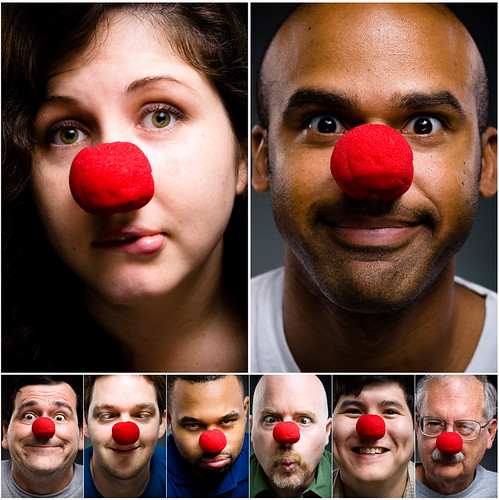
Continuing on the occasional red nose portrait theme. Chris had his lights set up for another portrait project so I borrowed his pattern. Thanks to everyone who let me shoot them looking silly.

Friday, September 19, 2008

a direction

inspired

I was pointed towards a couple of really amazing photographer's web sites today. I'm partly inspired and partly depressed in equal measure, but think they are all worth sharing. The common thread in Eric Ogden's images is beautiful, found light mixed with some additional strobe. Along with lovely locations and a great sense of story. Image, after depressingly great image, they unfolded infront of me. Looking for more, I found this interview with him from PDN that describes a bit about his process. Looking through his images pushed me to revisit Aaron Hobson's equally cinematic work. A common thread of narrative as well as lighting here I feel.

Another that blows me away is Mark Tucker. Again lovely light and clean, great portraiture. Inspired all over again. To finish off this linkfest, I went back and looked at Mark Robert Halper's site. The last two maybe don't have quite the cinematic feel of Eric Ogden's sumptuous images but all share a common thread of found light mixed in with artificial that really appeals to me. The idea of working in a studio doesn't interest me much at all, I've realised more and more. Setting up lights in a dark corner of a location has a similar lack of appeal - I want to find great light and enhance or play with it, rather than making it all from scratch. I need to stay on that thread for a while.

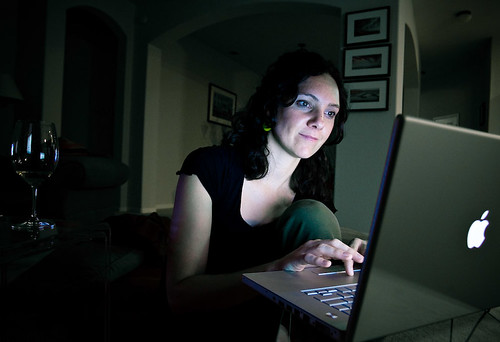
This shot above of Amanda is perhaps not in the same league, but shares some queues, using the light that was there in interesting ways. It has the advantage that I didn't have to get off the couch to take it and play around with the lighting options. Something to explore further over the months to come. I've spent a year or so getting comfortable with finding and recognising good available light - now I want to add and enhance, rather than overpower or replace. Working out what I like and maybe even more so, working out what I don't like helps move things forward.


Thursday, September 18, 2008

an end to estivation

we are...

We had our first almost cool days in Austin this week. A window open during the day, a cooler breeze. I seem to be waking up from the summer back to wanting to take pictures too. I can feel that old, familiar itch in the finger. My brain has started picking over project ideas, finding inspiration here and there and wanting to start putting some pictures together. I don't think I'm quite ready for another SoFoBoMo sprint, but I do feel the motivation coming back. Perhaps it is part of getting better and the promise of more mobility, or maybe just that it isn't so damn hot outside.

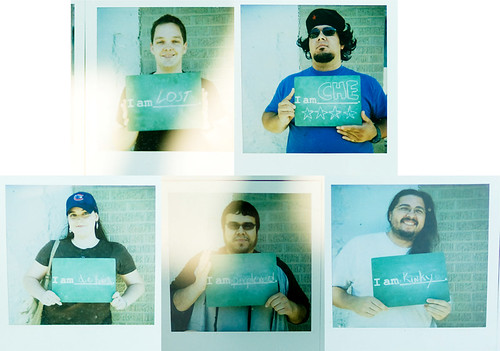
I've been fascinated by projects that get the subjects to share something of themselves to the viewer. Often this takes the form of a tablet, mini-white board or sign that gets attached to the portrait, or held in the hand. I don't really know why these capture my imagination so much - you are given a very tiny window into the subject, beyond just how they appear in the portrait. It might be true, it might be false, but that extra insight feeds the nosiness and curiosity about people that I have. At the same time, I wonder if it is more of a gimmick than an insight. Perhaps something more straight up, direct and honest is called for. John Setzler has used this approach to good effect, with his Tell The World SoFoBoMo project, and others. The I Am project for Art City Austin (some shots above) was another enjoyable project to view.

At the same time, I just watched this 5 minute documentary on Avedon's portraits. Nothing clever here, just great portraits, cleanly done. Then, at the end of the documentary, a link to another. An interview with Frank Warren. More food for thought. People sharing secrets, anonymously via the mail. But would these people share so apparently deeply, with their picture attached? A quick search found Frank's blog where he posts some of the more interesting secrets he receives. I now realise I've seen this before, but maybe needed to see it again, now. Even if this doesn't go anywhere, I'm at least thinking up ideas. I may even dust off the red nose this weekend and take some portraits.